Flower Tattoos: Meaning and Design Guide
Flowers are the most tattooed subject on earth, and it is not close. Walk into any studio and the flash on the wall will be at least a third botanical: roses on the traditional sheets, peonies on the Japanese ones, small sprigs of blossom on the fine-line pages near the front desk. The reason is simple. A flower can carry almost any meaning you ask of it, and it fits almost any part of the body.
That flexibility is also the problem. If you search for a flower tattoo you get ten thousand pictures and very little help deciding which one is yours. This guide is built to narrow it down. It covers the five flowers people actually get most often, what each one has historically meant, how the common styles change the result, and where on the body each design tends to sit best. Every design mentioned here exists inside the Miami Ink Tattoo Designs library, so once you know what you want you can print it at size and take it to your artist.
Key Takeaways
- Roses remain the most requested flower tattoo, and they read differently in traditional, fine-line and black-and-grey styles.
- Peonies carry prosperity and good fortune in Japanese and Chinese work, and they scale well to large pieces on the thigh, ribs or back.
- Lotus designs symbolise growth out of difficulty, which is why they are so often chosen to mark a hard year.
- Cherry blossoms stand for how short life is, and they suit flowing placements like the collarbone, spine or forearm.
- Miami Ink Tattoo Designs members can browse thousands of flower designs across 60+ categories and print any of them at true scale before booking.
Find your flower tattoo design
Members browse 30,000+ designs across 60+ categories, pin the ones worth a second look, and print them at true scale before booking.
Rose tattoos
The rose has been tattooed continuously for longer than almost any other design. Sailors wore them in the nineteenth century, often paired with a name or a dagger, and the shape survived every shift in fashion since because it works at any size. A rose reads clearly at two inches on a wrist and it still reads at fourteen inches across a back.
Meaning depends on how it is drawn and what sits beside it. On its own a rose is usually read as love, beauty or devotion. Add a dagger through it and the reading turns towards betrayal or loss that has been survived. Add thorns and a stem and it leans towards the idea that something worth having costs something. Colour shifts it again: red for love, white for remembrance, black for grief or for pure graphic weight with no sentiment attached at all.
Traditional roses
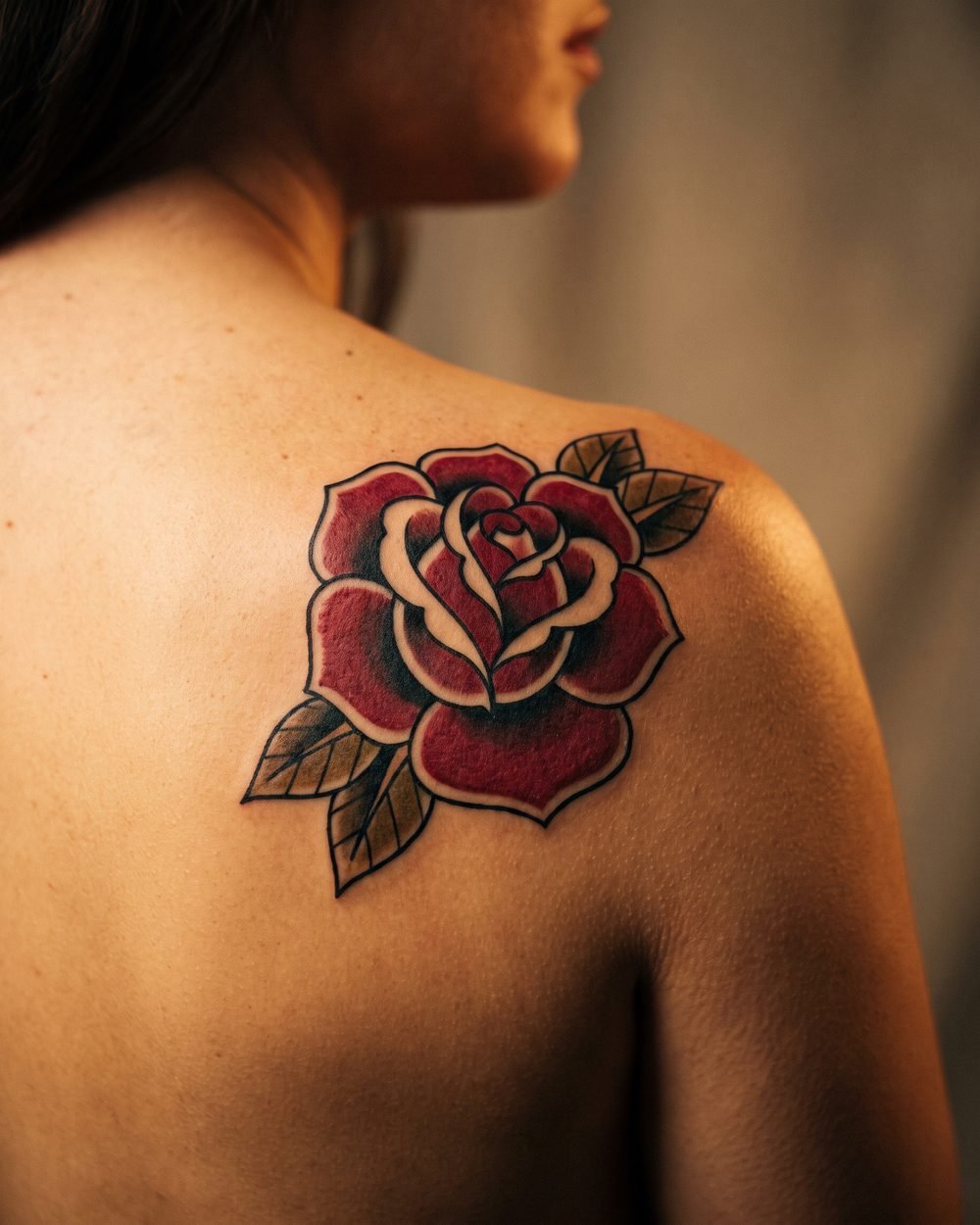
American traditional roses use a heavy outline, a small number of flat colours and shading that sits in blocks rather than gradients. That construction is the reason those tattoos from the 1940s are still legible today. Bold lines spread slightly under the skin over decades, and a design built with gaps between its elements survives that spread. If you want a tattoo that still looks sharp in twenty years, this is the safest botanical style to choose.
Fine-line roses
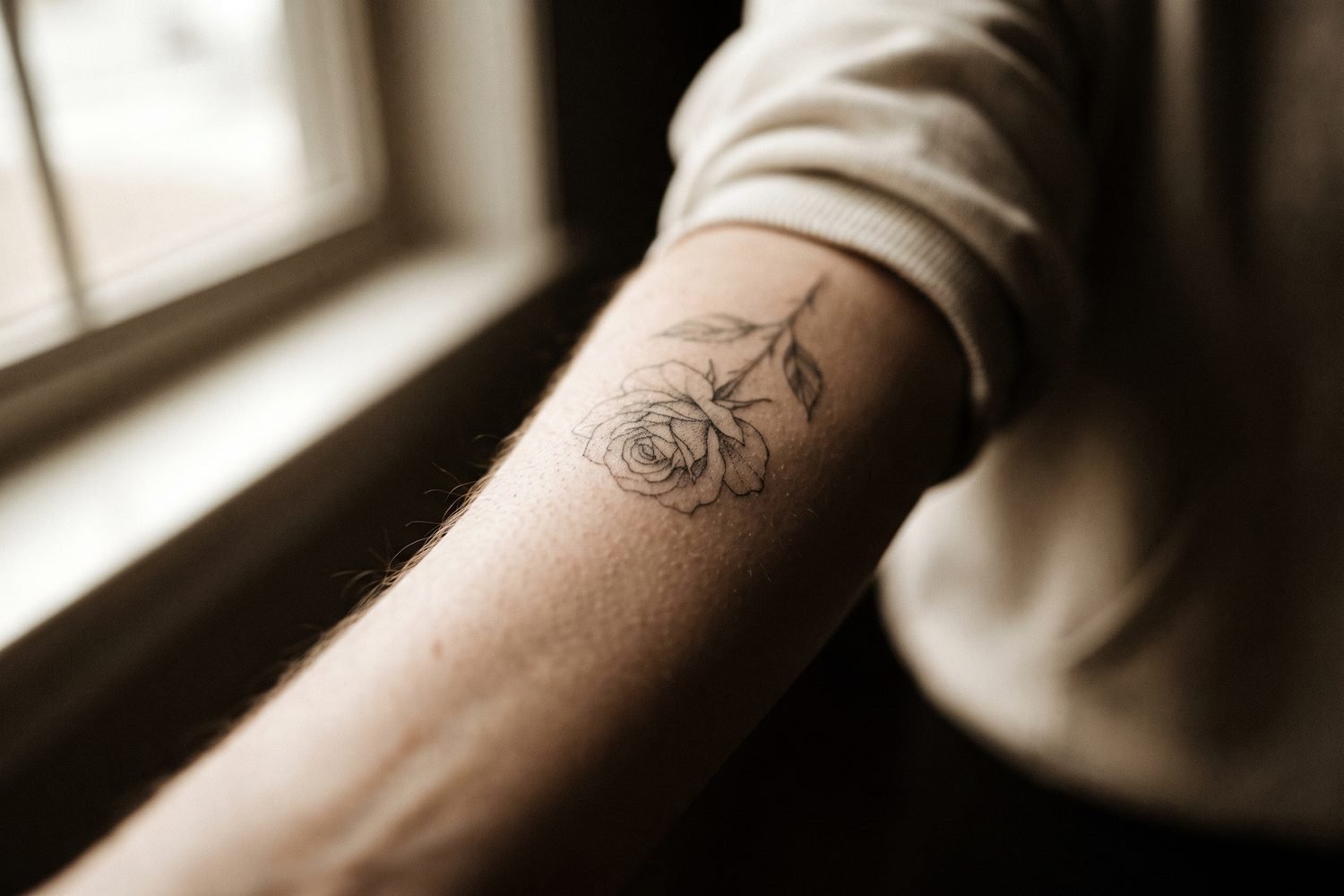
Fine-line work uses a single needle or a tight grouping to draw the flower in hairline strokes with little or no fill. The result is quieter and more illustrative, and it suits small placements like the inner forearm, the ankle or the ribs. The trade-off is longevity. Very thin lines placed close together can blur into one another over time, particularly on high-friction areas such as hands and feet, so most artists will space the linework more generously than the original drawing suggests.
Black and grey roses
Black and grey sits between the two. The outline is lighter than traditional work but the petals are modelled with smooth grey wash, which gives depth without colour. It photographs well, it ages predictably, and it pairs easily with other black and grey pieces if you are building a sleeve over several sessions.
Peony tattoos
In Japanese tattooing the peony is called botan, and it is the flower of the lion. It appears constantly alongside the shishi, the guardian lion, and the pairing is deliberate: the lion is force, the peony is what force protects. On its own the peony carries prosperity, good fortune and a kind of confident abundance. In Chinese symbolism it is close to a national flower and reads as wealth and honour.
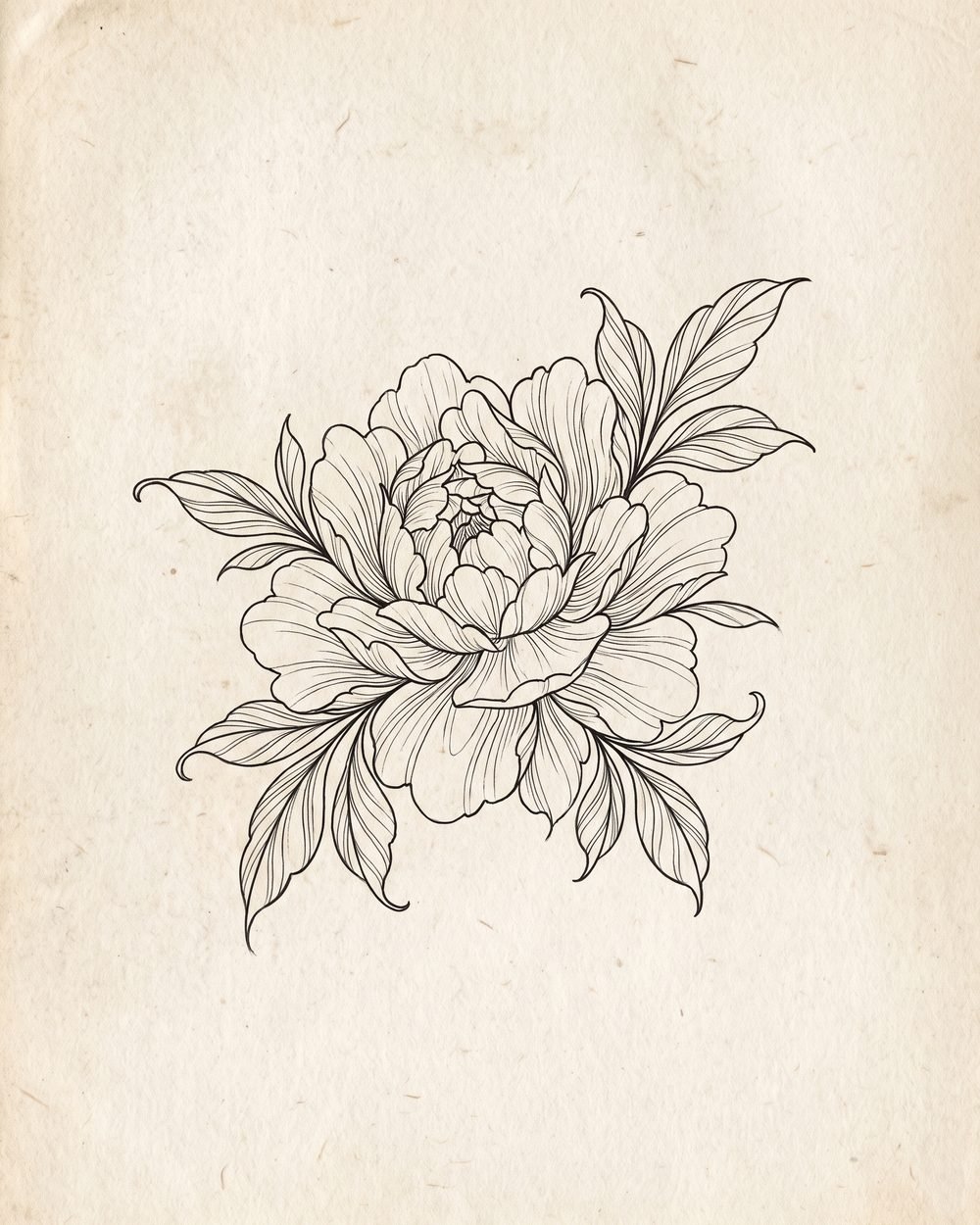
Structurally the peony is a gift to a tattooer. It has many overlapping petals and no single correct silhouette, which means it can be stretched, curled and angled to follow the body in a way that a tighter flower like a daisy cannot. That is why it turns up so often in large-scale work. A peony can fill a hip, wrap a thigh or anchor the top of a back piece, and it can be reshaped to fit the space without looking distorted.
If you are considering a first large tattoo, a peony is a practical choice for a second reason. Because the petals are layered, an artist can add to the design later. A single flower can become a cluster, and a cluster can grow leaves, water or wind bars into a full panel. Many Japanese-style sleeves begin as one botan on the outer arm. For related motifs, the Asian tattoo designs category collects the wider tradition these flowers sit inside.
Lotus tattoos
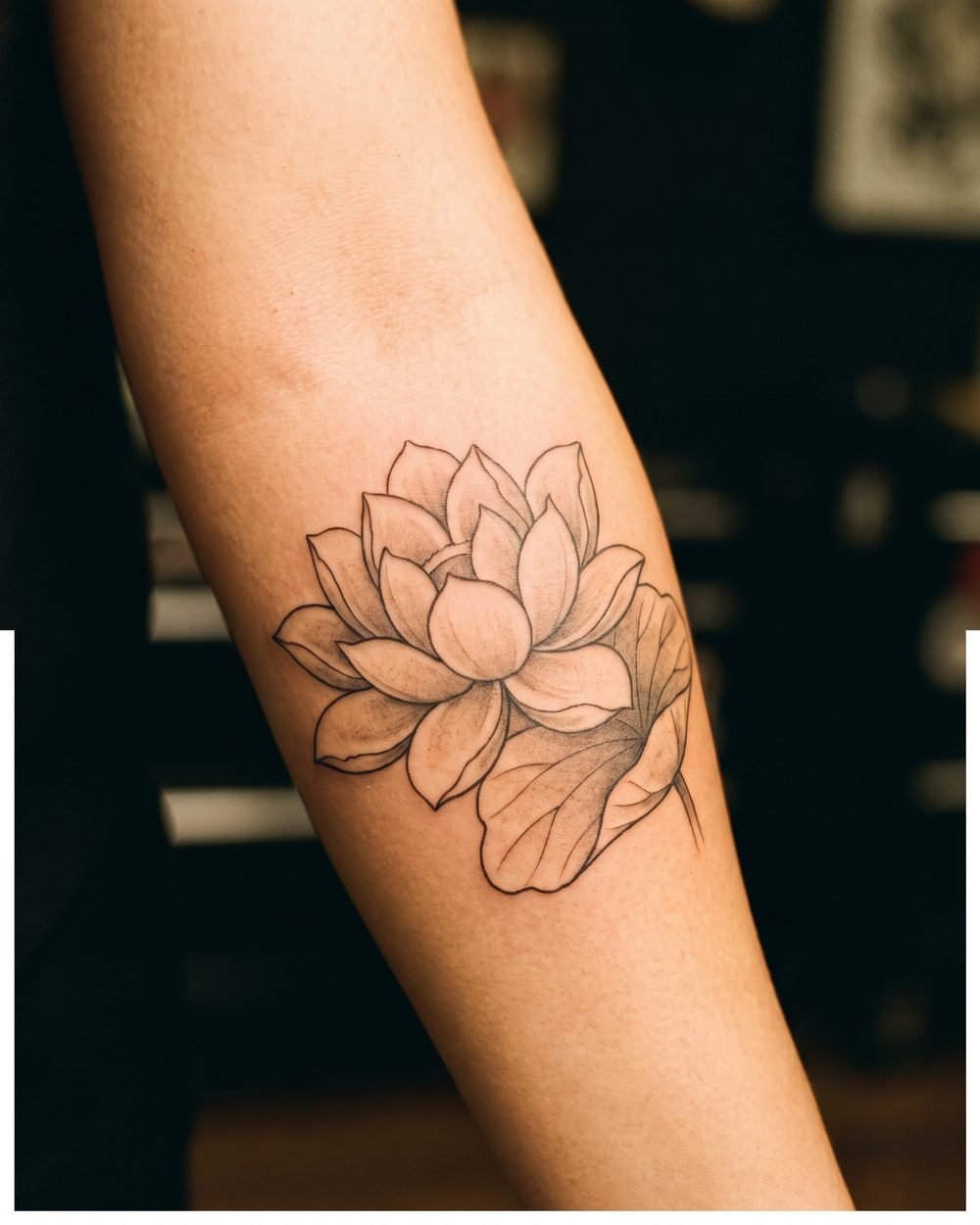
The lotus grows out of mud and opens clean above the water. That fact does most of the symbolic work. Across Buddhist and Hindu tradition the flower stands for rising through difficulty without being marked by it, and for spiritual growth that has been earned rather than given. It is one of the few tattoo subjects whose meaning is close to universal, which is part of why it is chosen so often to mark recovery, sobriety, the end of an illness or the end of a bad year.
Design conventions vary by tradition and it is worth knowing which one you are drawing on. Japanese-influenced lotus work tends towards fine outlines, layered petals and light grey wash, often with the flower shown in profile or three-quarter view. Indian and Nepali imagery more often shows the flower from directly above, symmetrical, with a defined seed pod at the centre and a set number of petals. Neither is more correct, but mixing conventions carelessly tends to produce a design that reads as generic.
Placement follows the shape. An overhead symmetrical lotus wants a flat, centred area: the sternum, the middle of the back, the back of the neck. A profile lotus follows a limb comfortably and sits well on a forearm or calf. Keep the interior linework spaced if you are going small, because the seed pod and petal creases are the first details to close up as the tattoo settles.
Cherry blossom tattoos
Sakura are tattooed for the opposite reason to most flowers. They are not chosen for permanence, they are chosen because they fall. In Japan the blossom season lasts a week or two and the whole cultural weight of the flower sits in that brevity: beauty is real precisely because it does not last. Tattooed, it usually means an acceptance of impermanence, and often marks a person who has lost someone or come close to it.
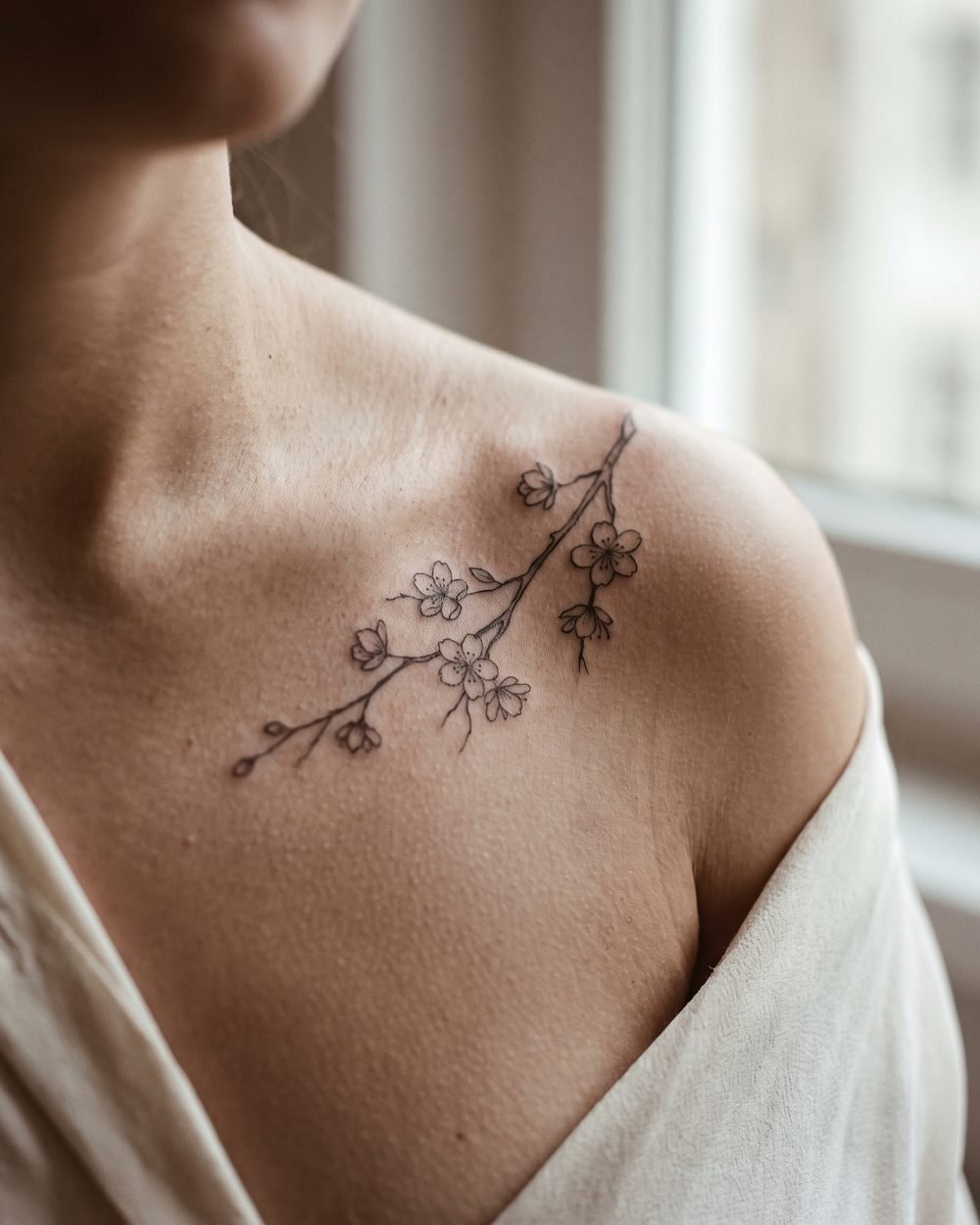
In classical Japanese work the blossoms rarely appear alone. They are scattered across a larger composition as loose petals carried on wind bars, filling the space between bigger elements. In contemporary Western fine-line work the branch itself has become the subject: a thin limb with a handful of open flowers and a few buds, drawn delicately and placed to follow the body.
That second approach is why sakura sits so well on flowing placements. A branch traces the collarbone naturally, runs the length of a spine, or curves around a shoulder and down the upper arm. Because the design is mostly negative space, it stays readable when it is small, and it can be extended later by adding more branch rather than redrawing what is already there.
Chrysanthemum tattoos
The chrysanthemum, kiku in Japanese, is the imperial flower and the one most associated with long life. Its sixteen-petal form is the crest of the Japanese imperial family, which is worth knowing before you commit to a literal reproduction of that specific arrangement. Most tattoo chrysanthemums are drawn more loosely, with dense overlapping petals radiating from a tight centre, and they read as longevity, endurance and a kind of settled dignity.
Western meaning runs differently and it is worth being aware of the gap. In much of Europe the chrysanthemum is a funeral flower, brought to graves rather than given to the living. Neither reading is wrong, but if the tattoo is meant to be understood by people around you it is reasonable to think about which tradition they will read it through.
Visually the kiku is the densest of the five flowers here. It is almost all petal and very little stem, which makes it excellent as a filler element in a larger composition and demanding as a standalone small piece. Under two inches the petals tend to merge. If you want one small, ask your artist to reduce the petal count rather than shrink the whole drawing.
Flower meanings and placement compared
The quick version, if you are choosing between the five:
| Flower | Common symbolism | Placements it suits |
|---|---|---|
| Rose | Love, devotion, beauty that costs something | Forearm, shoulder, ribs, hand |
| Peony | Prosperity, good fortune, confident abundance | Thigh, hip, back, upper arm |
| Lotus | Growth through hardship, spiritual progress | Sternum, centre back, forearm, calf |
| Cherry blossom | Impermanence, beauty in what is brief | Collarbone, spine, shoulder, ankle |
| Chrysanthemum | Longevity, endurance, dignity | Upper arm, thigh, as filler in larger work |
Why flowers dominate tattoo flash
Botanical tattooing is older than the modern studio. Preserved skin from the ancient world shows plant motifs, and by the time electric machines arrived in the 1890s flowers were already standard flash. Part of that is practical: a flower has a clear silhouette, it does not need to be recognisable as a specific person or place, and it can be drawn convincingly at almost any size by an artist working from memory.
The other part is that flowers absorb meaning easily. A portrait means one thing. An anchor means a fairly narrow set of things. A rose can mean love, loss, a name, a date, a city, or nothing at all beyond the fact that you liked the shape. That openness is why the same five flowers keep reappearing across traditions that otherwise share very little: Japanese irezumi, American traditional, Central European folk work and contemporary fine-line all lean on botanical subjects heavily.
It also explains why flowers are the most common choice for covering or reworking old tattoos. A dense flower can be shaped around whatever is already there in a way a rigid geometric design cannot, and its irregular edges hide the boundary of the old piece.
Choosing size and placement
Most regret about flower tattoos is not about the flower. It is about scale. A design that looked balanced on a screen gets printed at three inches, and half the interior detail disappears within a year because there was never enough room for it to sit apart.
The practical test is simple and you can do it at home. Print the design at the exact size you are considering, cut it out and tape it where it will go. Look at it in a mirror, then look at it again the next morning. Two things become obvious quickly: whether the size is right for the body part, and whether the orientation follows the limb or fights it. Curved placements such as the forearm, calf and ribs want designs with a natural diagonal. Flat placements such as the sternum, upper back and shoulder blade suit symmetrical work.
Skin also moves. A design across the ribs will distort when you breathe and bend, and one on the inner bicep will fold. Artists account for this by placing key linework away from the deepest crease, which is another reason to bring a printed reference rather than a phone screenshot. Your artist can hold paper against you and rotate it. They cannot do that with a photo on a screen.
Picking a style: fine-line, traditional or black and grey
Style matters more than subject for how the tattoo will look in a decade. The three you will most often be choosing between behave differently over time.
Fine-line gives the most detail per square inch and the most delicate result. It is the right choice for small, quiet botanical work. It needs the most careful placement, because thin lines close together blur soonest on areas that move or rub.
American traditional is the most durable. Heavy outlines, limited colour and generous spacing mean the design stays readable as it softens. If you want a flower that still looks like that flower in 2050, this is the answer. Browse the tribal tattoo designs category if you want to see how similar bold-line logic works on non-botanical subjects.
Black and grey is the middle path and the easiest to extend. Because it uses no colour it blends with almost any future work, which makes it the sensible default if you expect this to be the first of several pieces rather than the only one.
Looking after fine botanical linework
Flower tattoos, particularly fine-line ones, are more sensitive to the first three weeks than heavier work. The lines are thin, so the amount of ink holding each one is small, and anything that lifts the healing skin early takes some of that line with it.
The basics do not change from any other tattoo. Keep it clean, keep it lightly moisturised rather than smothered, and leave the flaking alone. What is worth adding for botanical work specifically is sun discipline. Thin black lines fade faster and more visibly than solid blocks of colour, and a fine-line peony on a forearm will spend more time in daylight than almost any other placement. Sunscreen on a healed tattoo is the single cheapest thing you can do to keep it sharp.
Expect some softening regardless. A tattoo that looks slightly too spaced out on day one is usually the one that still reads correctly in ten years, which is why experienced artists will often talk you out of cramming detail into a small flower. If you want the full routine, the site has a longer guide on tattoo aftercare do’s and don’ts.
Flower tattoo designs at Miami Ink Tattoo Designs
The reason most people end up frustrated looking for a flower tattoo is not a shortage of images. It is that the images they find are screenshots. A saved photo from social media is somebody else’s finished tattoo at an unknown size, usually cropped, often reversed, and almost never printable at the scale you need. Your artist can work from it, but they are starting from a picture of a result rather than a drawing.
A membership library solves a narrower problem than people expect, and it is worth being precise about it. It gives you a large set of designs organised by subject so you can compare fifty roses side by side instead of scrolling, a way to save the ones that hold up on a second look, and files you can print and hold against your skin before anybody picks up a machine. Most designs in the library are full resolution, though the exact size varies depending on the source of the design. Every image can be pinned for reference at any time and shared with your tattoo artist.
Alongside flowers, the library covers more than 60 categories including Celtic tattoo designs, Aztec tattoo designs and butterfly tattoo designs, which pair naturally with botanical work in larger compositions.
Start browsing flower tattoo designs
Access the full library for $9.97 a month, cancel any time, with a 30-day money-back guarantee. Checkout completes securely on ClickBank.
Frequently asked questions
What flower tattoo designs does Miami Ink Tattoo Designs offer?
The library covers the full range of botanical work: roses in traditional, fine-line and black and grey, peonies and chrysanthemums in Japanese styles, lotus designs in both profile and symmetrical overhead forms, cherry blossom branches, sunflowers, lilies, daisies and wildflower arrangements. Designs sit inside a wider set of more than 60 categories, so botanical elements can be combined with other subjects for larger pieces.
What does a rose tattoo mean?
On its own a rose usually reads as love, beauty or devotion. The meaning shifts with what surrounds it. A dagger through the rose suggests betrayal or a loss that has been survived, thorns suggest that something worth having carries a cost, and colour changes it again: red for love, white for remembrance, black for grief or for pure graphic weight.
What is the best flower tattoo for a first tattoo?
A small to medium traditional or black and grey rose on the outer forearm is the most forgiving first flower. The placement is low on the pain scale, heals easily, and is simple to extend later. Bold linework also ages more predictably than very fine detail, so the result stays close to what you chose.
Do fine-line flower tattoos age well?
They age acceptably when they are placed and spaced properly. Thin lines spread slightly under the skin over years, so linework drawn very close together can merge. Good fine-line artists build in more space than the original drawing suggests and avoid high-friction placements such as hands, fingers and feet for delicate botanical work.
Where do flower tattoos hurt the least?
Outer forearm, outer thigh, calf and upper arm are the most comfortable placements because there is more muscle and fat between the needle and the bone. Ribs, sternum, spine, ankles and the tops of the feet are noticeably sharper. Sessions on flowing designs like cherry blossom branches are usually shorter, which also helps.
Can I print Miami Ink Tattoo Designs flower designs at full size?
Most designs are full resolution, though the size can vary depending on the source of the design. Every image can be pinned for reference at any time and shared with your tattoo artist. Printing a design and taping it in place is the fastest way to check that the scale and orientation work on your body.
What does a lotus flower tattoo symbolise?
The lotus grows out of mud and opens clean above the water, so it stands for rising through difficulty without being marked by it. Across Buddhist and Hindu tradition it also represents spiritual growth that has been earned. It is commonly chosen to mark recovery, sobriety or the end of a difficult period.
How much does a flower tattoo cost?
Cost depends on size, style, placement and your artist’s hourly or minimum rate, which varies widely by city and by artist experience. Detailed colour work takes longer than simple linework of the same size. The reliable way to get a real number is to bring a printed design at the size you want and ask for a quote against it.
Are flower tattoos good for covering an old tattoo?
They are among the best options. Peonies and chrysanthemums in particular have dense overlapping petals and no single fixed silhouette, so they can be reshaped to sit over an existing design and absorb its dark areas. Any cover-up needs assessment in person, because what is possible depends on how dark and how large the original is.
How do I take a Miami Ink Tattoo Designs design to my tattoo artist?
Pin the designs you are considering, then print the one you settle on at the size you want it. Bring the printed sheet to your consultation rather than a phone screenshot. Paper can be held against your skin, rotated and trimmed, which lets your artist judge scale and placement immediately and adapt the drawing to your body.
Choosing yours
If you are still undecided, work backwards from placement rather than forwards from the flower. Decide where it goes, then pick the flower whose natural shape fits that space, then pick the style based on how long you want the detail to hold. That order avoids the most common mistake, which is falling for a design that was drawn for a different part of a different body.
Print your shortlist, hold it against your skin, and let it sit for a few days before you book. The flowers that survive that wait are usually the right ones.
Browse other tattoo design categories
- Abstract tattoo designs
- Alien tattoo designs
- Ambigram tattoo designs
- Angel tattoo designs
- Animal tattoo designs
- Asian tattoo designs
- Aztec tattoo designs
- Belly button tattoo designs
- Biker tattoo designs
- Bird tattoo designs
- Butterfly tattoo designs
- Cartoon tattoo designs
- Celebrity tattoo designs
- Celtic tattoo designs
- Chinese tattoo designs
- Chinese zodiac tattoo designs
- Clown tattoo designs
- Cross tattoo designs
- Demon tattoo designs
- Devil tattoo designs
- Dolphin tattoo designs
- Dove tattoo designs
- Dragon tattoo designs
- Eagle tattoo designs
- Star tattoo designs
- Tribal tattoo designs
Written by the Miami Ink Tattoo Designs team. We have run a membership tattoo design library since 2009, serving members and tattoo artists who use the collection at the chair. Design guidance here is general. Your artist is the right person to advise on your skin, your placement and your specific piece.