Tattoo Design Reference Library by Style
Miami Ink Tattoo Designs is a membership library of more than 30,000 professional tattoo designs, organised into 60+ categories inside the member area and covered here by 29 public category guides. It is used by two very different groups: people working out what to get, and tattoo artists who need reference at the chair.
Those two jobs need different things from a page like this, so the shortcuts are up front.
Key Takeaways
- The member library holds 30,000+ designs across 60+ categories, with 29 of those categories covered by a full public guide on this site.
- Categories are grouped into four clusters: creatures, myth and spirit, culture and script, and style and placement.
- If you are planning a tattoo, start with the style guides and the practical articles on pain, aftercare and printing at true scale.
- If you are an artist, the library works as chairside reference: pin boards per client, lettering sets, and the PDF reference collection.
- Designs are downloadable and printable, so you can test size and placement on skin before anyone picks up a machine.
Browse tattoo designs by category
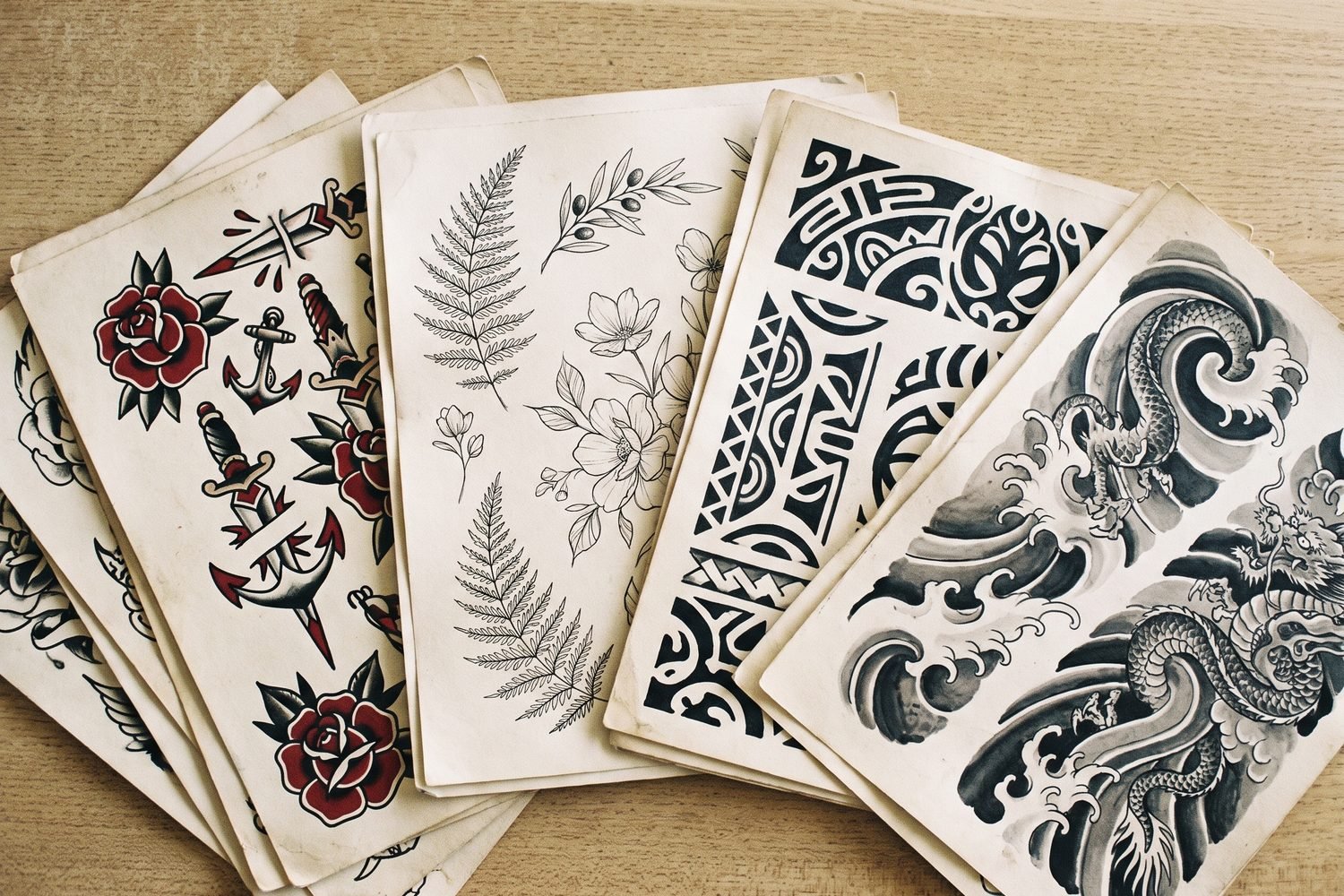
All 29 category guides, grouped the same way as the index on the home page. Each one covers meaning, common styles and where the design tends to sit best on the body.
Creatures
- Animal tattoo designs: Wolves, lions, bears and the rest of the animal kingdom, from realistic portraits to bold traditional shapes.
- Bird tattoo designs: Swallows, ravens and songbirds, the oldest shorthand in tattooing for freedom and safe return.
- Butterfly tattoo designs: Transformation and rebirth, and one of the most adaptable shapes for small placements.
- Dolphin tattoo designs: Playfulness, intelligence and the sea, usually drawn in clean curved linework.
- Dove tattoo designs: Peace, faith and remembrance, common in memorial pieces and religious work.
- Dragon tattoo designs: Power and protection, from Western winged beasts to serpentine East Asian forms.
- Eagle tattoo designs: Freedom, vision and patriotism, with strong traditions in both Americana and Aztec work.
Myth & Spirit
- Alien tattoo designs: Science fiction imagery, from classic grey heads to full abduction scenes.
- Angel tattoo designs: Guardianship and loss, spanning cherubs, wings and full memorial compositions.
- Clown tattoo designs: From circus nostalgia to the darker horror end, a style with a lot of range.
- Cross tattoo designs: Faith and remembrance, in Latin, Celtic, gothic and rosary variations.
- Demon tattoo designs: Inner conflict and things confronted rather than avoided, usually in heavy black work.
- Devil tattoo designs: Mischief and temptation, often drawn with a lighter, more playful traditional touch.
- Skull tattoo designs: Mortality in every register, from Americana flash to sugar skull calaveras.
Culture & Script
- Ambigram tattoo designs: Words designed to read the same inverted, a lettering trick that needs careful drawing.
- Asian tattoo designs: A broad category spanning several distinct East Asian traditions and motifs.
- Aztec tattoo designs: Mesoamerican calendars, warriors and geometric stonework patterns.
- Celtic tattoo designs: Endless knotwork, spirals and crosses drawn from insular manuscript art.
- Chinese tattoo designs: Characters, dragons and imagery from Chinese tradition, where translation accuracy matters.
- Chinese zodiac tattoo designs: The twelve animals of the lunar cycle, often chosen for a birth year.
- Japanese tattoo designs: Irezumi proper: dragons, koi, Hannya masks and the wave and cloud backgrounds that bind them.
- Tribal tattoo designs: Bold black linework with roots in Polynesian, Maori and Borneo traditions.
Style & Placement
- Abstract tattoo designs: Shape, negative space and colour without a literal subject.
- Belly button tattoo designs: Designs drawn specifically to work with the navel and the curve of the stomach.
- Biker tattoo designs: Heavy outlines, engines, flames and skulls, built to read at a distance.
- Cartoon tattoo designs: Character work and bold animation-influenced linework.
- Celebrity tattoo designs: Well known tattoos and the stories behind them, useful as reference rather than to copy.
- Flower tattoo designs: Roses, peonies, lotus and sakura, the most tattooed subject on earth.
- Star tattoo designs: Nautical stars, constellations and simple geometric fills.
Browse the full design library
Members open all 30,000+ designs across 60+ categories, pin the ones worth a second look, and print them at true scale before booking.
How the categories are grouped
The four clusters are not arbitrary. They reflect the different reasons people arrive at a subject, and knowing which one you are in usually shortens the search.
Creatures covers animals real and mythological. People come here either because the animal means something personal, often a pet or a spirit animal, or because they want a specific visual energy: the coiled length of a dragon, the spread of a bird in flight.
Myth and spirit holds the subjects about belief, mortality and the parts of life that are hard to say plainly. Angels, crosses, demons and skulls all sit here, and this is the cluster where the same image most often means opposite things to different wearers. A skull can be a warning or a memorial. A cross can be faith or remembrance.
Culture and script covers work rooted in a specific tradition, including Japanese, Celtic, Aztec, Chinese and tribal, along with lettering. These are the categories where accuracy matters most, both because the motifs follow rules and because getting a translation or a knot pattern wrong is permanent.
Style and placement is the practical cluster, grouping subjects by how and where they are worn rather than what they depict. If you know you want something small on a wrist, or bold enough to cover an old piece, this is the faster entry point.
What to expect on time and cost
Two questions come up constantly and neither has a single answer, but both have useful ranges.
Cost depends on size, style, placement and your artist’s hourly or minimum rate, which varies widely by city and by experience. Detailed colour work takes longer than simple linework at the same size, and most shops have a minimum charge that makes very small tattoos cost more per inch than you would expect. The reliable way to get a real figure is to bring a printed design at the size you want and ask for a quote against it.
Time follows the same logic. A small fine-line piece is often under an hour. A detailed forearm design is usually a single longer session. Anything approaching a sleeve is multiple sessions across months, and in Japanese work the background alone can account for more chair time than every motif combined. Booking a consultation before the first session is normal and worth doing even when the shop does not require it.
Popular styles at a glance
If you are choosing between broad styles rather than subjects, this is the short version.
| Style | Best for | Typical symbolism | Guide |
|---|---|---|---|
| American traditional | First tattoos, any placement, ages best | Mortality, love, accepted risk | Skull |
| Fine-line botanical | Small, quiet placements | Love, growth, remembrance | Flower |
| Japanese irezumi | Sleeves and large panels, planned upfront | Protection, perseverance | Japanese |
| Tribal | Shoulders, arms, bold coverage | Heritage, strength | Tribal |
| Celtic knotwork | Bands, forearms, continuous shapes | Continuity, ancestry, faith | Celtic |
| Realism | Larger areas, experienced artists only | Portraiture, memorial | Animal |
| Lettering and script | Ribs, forearms, collarbone | Names, dates, quotes | Ambigram |
| Neo-traditional | Mid-size colour pieces | Nature, folklore, portraiture | Butterfly |
| Blackwork and geometric | Cover-ups, bold statements | Abstraction, pattern | Abstract |
What makes a tattoo design work
Most designs that disappoint people were not bad drawings. They were drawings that were never going to survive being tattooed at the size and place they were tattooed. Three things separate a design that holds up from one that does not, and none of them is about how good the artwork looks on a screen.
Space between the marks
Ink spreads slowly in the skin over years. Lines thicken slightly and the smallest gaps between them close first. A design built with generous space between its elements absorbs that change and still reads correctly decades later. A design with detail crammed into every square inch turns into a dark patch. This is the single reason American traditional work from the 1940s still looks sharp while a lot of highly detailed modern work does not.
A silhouette that survives at a distance
Squint at the design, or shrink it on screen until it is an inch wide. If it still reads as a recognisable shape, it will work as a tattoo. If it collapses into a grey blob, the detail is carrying the design rather than the structure, and detail is the part that fades. Traditional flash is built this way deliberately, which is why it is still the safest starting point for a first tattoo.
A shape that suits the body part
Bodies are curved and they move. A design with a natural diagonal suits a forearm or a calf, because those surfaces are round and the eye travels along them. A symmetrical design wants a flat, centred placement like the sternum, upper back or shoulder blade. Putting a symmetrical design on a curved limb is the most common reason a technically good tattoo looks subtly wrong.
Choosing between subjects
People usually arrive with either a meaning they want to express or an image they like, and the two routes need different approaches.
If you are starting from meaning, the category guides are the faster path, because each one covers what the subject has historically carried and how that changes with style. Grief, for example, is expressed very differently by a dove, a skull and rose and a sugar skull calavera, and the difference is not decorative. One is peaceful, one is a general statement about mortality, and one honours a specific person inside a specific tradition.
If you are starting from an image, work out what family it belongs to before you commit. A lot of designs that look distinct are variations inside one tradition, and knowing that opens up options you had not considered. Someone drawn to a koi is usually also drawn to dragon designs, because in Japanese work they are the same story at different stages.
Either way, look at more of the category than the first few results. The most-shared design in any subject is rarely the best one for a specific body, and comparing thirty variations is how you find out what you actually respond to rather than what happens to be popular.
Planning your first or next tattoo
Most of the difficulty in getting a tattoo happens before the appointment. Choosing the subject is the fun part. Working out what size it needs to be, where it sits, how much it will hurt and how to hand your artist something useful is where people get stuck, and it is where a bad decision is most expensive.
Start with the practical questions
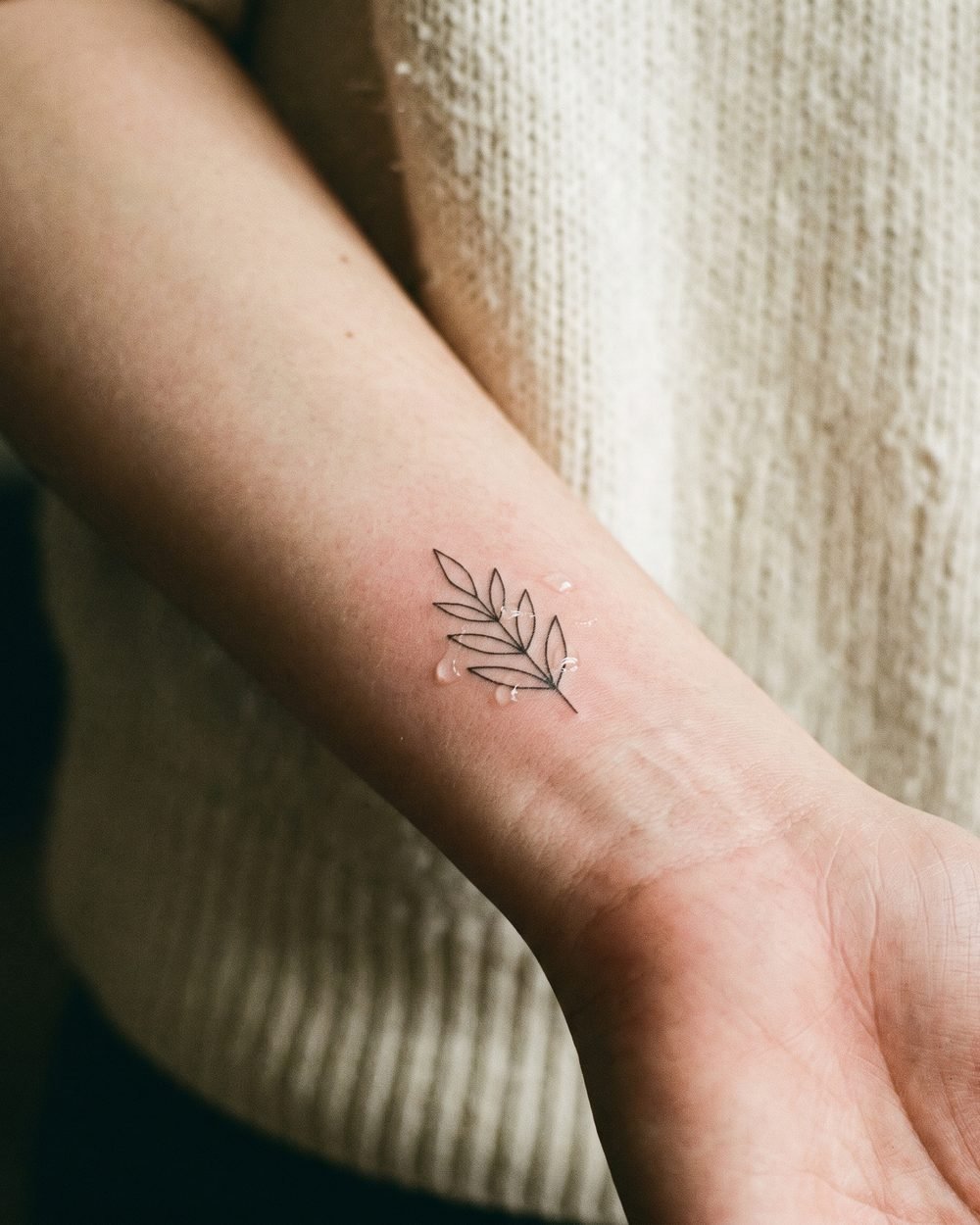
Three things decide more about the finished result than the drawing does: size, placement and style. A design that looks right on a screen can lose half its detail printed at three inches. A shape drawn on a flat page may fight the curve of a forearm. And a very detailed style will soften faster than a bold one, which matters more the younger you are when you get it.
If this is your first, How to Get Your First Tattoo covers the process end to end, and How to Get A Virtually Pain-Free Tattoo is worth reading before you choose a placement, because the difference between an outer thigh and a sternum is not small.
Then work out what happens after
Healing determines how the tattoo looks for the rest of your life, and the first three weeks do most of that work. Tattoo Aftercare Do’s and Don’ts is the practical routine. If you are still narrowing down the idea itself, Tattoo Inspiration: A Guide to Popular Designs is a broader survey than any single category guide.
Good starting categories
If you have no fixed idea yet, the categories people most often land on first are flower tattoo designs for something quiet and adaptable, skull tattoo designs if you want something with more weight to it, and star tattoo designs for small, simple pieces that are easy to add to later.
For tattoo artists
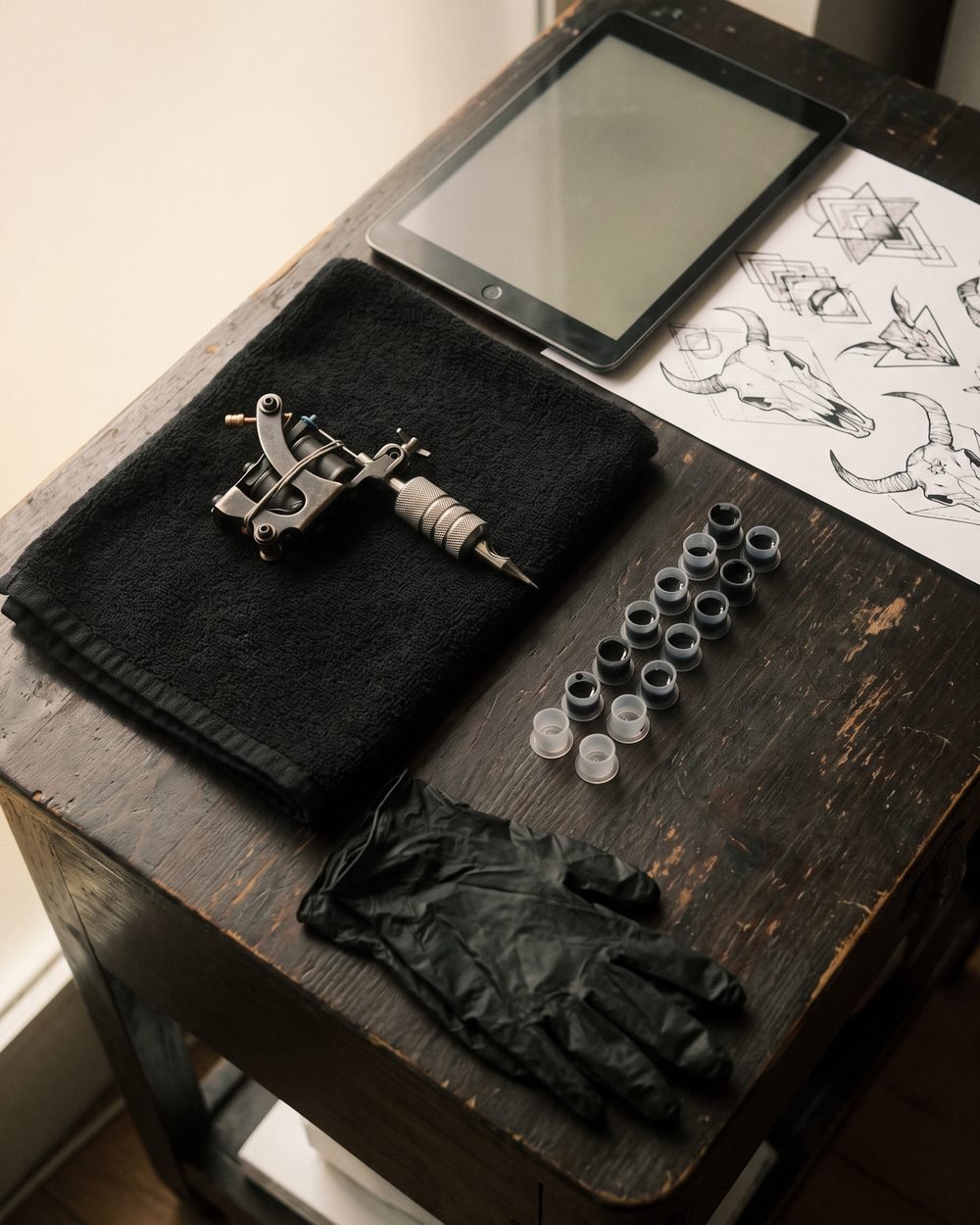
Artists use the library differently from collectors. The value is not inspiration, it is speed at the chair: a client arrives with a vague idea, and you need to move them to something drawable inside a consultation rather than across three emails.
Chairside reference
The practical use is pulling up thirty variations of a subject in front of a client and letting them point. Comparing designs side by side settles arguments about size and style far faster than describing them does, and it gives you a concrete starting point to draw from rather than a mood board of other artists’ finished work.
Client pin boards
Designs can be pinned into albums, which in practice means one board per client. Everything they have reacted to lives in one place, so the second consultation does not start from nothing and you are not scrolling a message thread looking for the reference they liked in March.
Lettering and reference material
The membership includes a lettering and fonts collection for names, dates and quotes, which removes the most tedious part of script work, and a PDF reference library covering meanings, placement and aftercare, including the Tattoo Bible volumes. Full details of what is included are on the features page, and the Ultimate Guide to Tattoo Stencils covers getting a design from file to skin cleanly.
Categories that come up most often in professional use are Japanese tattoo designs for large planned pieces, tribal tattoo designs for bold coverage and cover-ups, and Celtic tattoo designs, where getting knotwork to actually connect is the hard part.
How to use a design once you have chosen it
A design is only useful if your artist can work from it. The step people skip is printing.
Print the design at the size you want it, cut it out, and tape it where it will go. Look at it in a mirror, then again the next morning. This answers two questions no screen can: whether the scale suits the body part, and whether the orientation follows the limb or fights it. Take the printed sheet to the consultation. Paper can be held against skin, rotated and trimmed. A phone screenshot cannot.
Most designs in the library are full resolution, though the size can vary depending on the source of the design. Every image can be pinned for reference at any time and shared with your tattoo artist. If you want a fuller walkthrough of turning a reference into something workable, see Create Unique Tattoo Design in 3 Easy Steps and Where To Get Tattoo Designs.
Why browse a library rather than search
The obvious objection to a design library is that images are free everywhere. That is true, and it misses what the difficult part actually is.
What you find in a general image search is other people’s finished tattoos. That is useful for mood and useless for execution. A photograph of a healed tattoo on someone else’s arm is cropped, taken at an unknown size, often mirrored, and gives your artist a picture of a result rather than a drawing to work from. It also carries a practical problem: most tattooers would rather not copy another artist’s work directly, and asking them to puts them in an awkward position.
A design library solves a narrower problem. Designs are organised by subject so comparison is possible, they are drawn as designs rather than photographed as outcomes, and they are files you can print. That last point is the one that changes consultations. Walking in with a printed sheet at the size you want, held against the place you want it, moves the conversation immediately to whether it works rather than what you mean.
None of that replaces your artist. It gives them something concrete to start from, which is usually the difference between a first appointment that produces a drawing and one that produces another appointment.
Start browsing tattoo designs
Access the full library for $9.97 a month, cancel any time, with a 30-day money-back guarantee. Checkout completes securely on ClickBank.
Frequently asked questions
What is the difference between a tattoo design and a tattoo style?
A design is the specific artwork, a particular rose, dragon or skull. A style is the visual language it is drawn in: American traditional, fine-line, Japanese irezumi, black and grey realism. The same subject drawn in two styles produces two very different tattoos, and style has more effect on how the piece ages than the subject does.
How many tattoo design categories does Miami Ink Tattoo Designs have?
The member library is organised into more than 60 categories covering over 30,000 designs. On this site there are currently 29 public category guides, each covering meaning, common styles and placement for that subject, grouped into creatures, myth and spirit, culture and script, and style and placement.
Are Miami Ink Tattoo Designs designs print-ready?
Most designs are full resolution, though the size can vary depending on the source of the design. Every image can be pinned for reference at any time and shared with your tattoo artist. Printing a design at the size you want and taping it in place is the fastest way to check scale and placement before booking.
Can tattoo artists use Miami Ink Tattoo Designs with clients?
Yes, and a good share of members are working artists. The common use is pulling up variations of a subject at the chair so a client can point rather than describe, then collecting everything they responded to into a single pin board for that client. The lettering collection and PDF reference library are aimed at professional use too.
Where should I start if I have never had a tattoo before?
Start with placement and size rather than the picture. Decide where it goes, then pick a subject whose natural shape suits that space, then choose a style based on how long you want the detail to hold. Bold styles age more predictably than very fine detail, which is why traditional work is the usual recommendation for a first piece.
Does Miami Ink Tattoo Designs cover Japanese and other cultural styles?
Yes. Irezumi has its own guide covering dragons, koi, Hannya masks and the wave and cloud backgrounds that hold a composition together, and there are separate guides for Celtic, Aztec, Chinese, tribal and the broader Asian category. Where a style carries cultural weight, the guides say so rather than treating it as decoration.
Can I use Miami Ink Tattoo Designs to plan a full sleeve?
You can plan one, though a sleeve is a composition rather than a collection of separate designs, particularly in Japanese work. Use the library to settle on subjects and style, then work with an artist who will design the whole limb before starting. Printing your shortlist at size makes that first conversation much more productive.
What does a Miami Ink Tattoo Designs membership cost?
There are two plans: a monthly membership at $9.97 per month that you can cancel at any time, and a 30-day membership at $24.97 as a single payment that does not rebill. Both open the same full library with no tiers and no locked folders, and both are backed by a 30-day money-back guarantee.
How do I find a specific tattoo design on Miami Ink Tattoo Designs?
Browse by category first, since the collection is organised by subject rather than by style. The category guides on this site are the public entry point, and inside the member area each category can be browsed in full and filtered down. Anything you like can be pinned into an album so you can compare a real shortlist later.
Are the tattoo designs suitable for a cover-up?
Many are. Cover-ups need dense, high-contrast subjects that can absorb what is underneath, which is why skulls, peonies, dragons and heavy blackwork are the usual candidates. What is actually possible depends on how dark and how large the existing tattoo is, so any cover-up needs assessing in person by your artist.
Where to go next
If you are planning a tattoo, pick two or three categories above and read the guides properly rather than scrolling the images. Print your shortlist, hold it against the place it is meant for, and let it sit a few days. The designs still there at the end of the week are usually the right ones.
If you are an artist, the fastest way to judge whether the library is useful is to open it during a consultation and see how quickly a vague brief turns into a drawable one.
All tattoo guides
The full set of practical articles on this site, alongside the category guides above.
- How to Get Your First Tattoo
- How to Get A Virtually Pain-Free Tattoo
- Tattoo Aftercare Do’s and Don’ts
- Ultimate Guide to Tattoo Stencils
- Create Unique Tattoo Design in 3 Easy Steps
- Where To Get Tattoo Designs
- Tattoo Inspiration: A Guide to Popular Designs
- Tattoo Removal, It Doesn’t Have To Hurt
- Celebrities and Chinese Tattoos
Written by the Miami Ink Tattoo Designs team. We have run a membership tattoo design library since 2009, serving members and tattoo artists who use the collection at the chair. Design guidance here is general. Your artist is the right person to advise on your skin, your placement and your specific piece.