Japanese Tattoos: Irezumi Meaning and Design Guide
Japanese tattooing is the most structured tradition in the craft. Where most Western tattoo styles are a way of drawing, irezumi is closer to a grammar: a fixed vocabulary of motifs, rules about which ones belong together, and a way of composing them across the whole body rather than as separate pictures. Learning a little of that grammar is the difference between a Japanese tattoo and a tattoo of a Japanese subject.
This guide covers the five motifs people ask for most often, what each one carries, and the backgrounds and pairings that hold a composition together. It also covers the history honestly, including the parts that are uncomfortable, because irezumi carries a social weight in Japan that it does not carry abroad and that is worth understanding before you wear it. Every design mentioned here sits in the Miami Ink Tattoo Designs library, so you can print one at size and take it to your artist.
Key Takeaways
- Irezumi is a composition system, not just a drawing style. Motifs are chosen to work together across a whole panel or bodysuit.
- Dragons mean wisdom and benevolent strength in the Japanese reading, closer to a protector than the Western destroyer.
- Koi symbolise perseverance, from the legend of the fish that climbs the waterfall and becomes a dragon.
- Backgrounds are structural: waves, clouds and wind bars tie separate motifs into one design and set the season.
- Miami Ink Tattoo Designs members can browse thousands of Japanese designs across 60+ categories and print any of them at true scale before booking.
Find your Japanese tattoo design
Members browse 30,000+ designs across 60+ categories, pin the ones worth a second look, and print them at true scale before booking.
What irezumi actually is
The Japanese tattoo tradition as it exists today took shape in Edo, now Tokyo, during the eighteenth and nineteenth centuries. Its immediate source was not tattooing at all but printmaking. In the 1820s the artist Utagawa Kuniyoshi produced a series of woodblock prints illustrating the Suikoden, a Chinese outlaw epic hugely popular in Japan, and he drew its heroes covered in elaborate tattoos. The prints sold enormously well, people wanted what the heroes had, and tattooers began working in the same visual language. That is why irezumi looks like ukiyo-e: it came directly out of it.
The people wearing it were mostly labourers, firemen and couriers, men who worked stripped to a loincloth and whose tattoos were therefore visible as a matter of course. Firemen in particular favoured dragons and water imagery, which is not subtle but was meant seriously as protection.
Tebori and the machine
Traditional irezumi is applied by hand with a tool called a nomi, a rod with needles bound to the end, worked into the skin at an angle. The technique is called tebori, literally hand carving. It is slower than a machine and produces a distinctive quality of colour packing that many collectors still prefer, particularly in large solid areas. Most Japanese-style work today is done with a machine, and many artists combine the two, lining with a machine and shading by hand.
The part people leave out
Tattooing was banned outright in Japan for most of the period between 1872 and 1948, driven by a government anxious about how the country appeared to Western visitors. The ban pushed the craft underground, and its association with criminal organisations dates largely from that period rather than from anything intrinsic to the art. The consequence is still visible: many onsen, gyms and public pools in Japan refuse entry to visibly tattooed people, and that applies to tourists as much as to anyone else. None of this is a reason not to get a Japanese tattoo. It is a reason to know what you are wearing and where.
Dragon tattoos
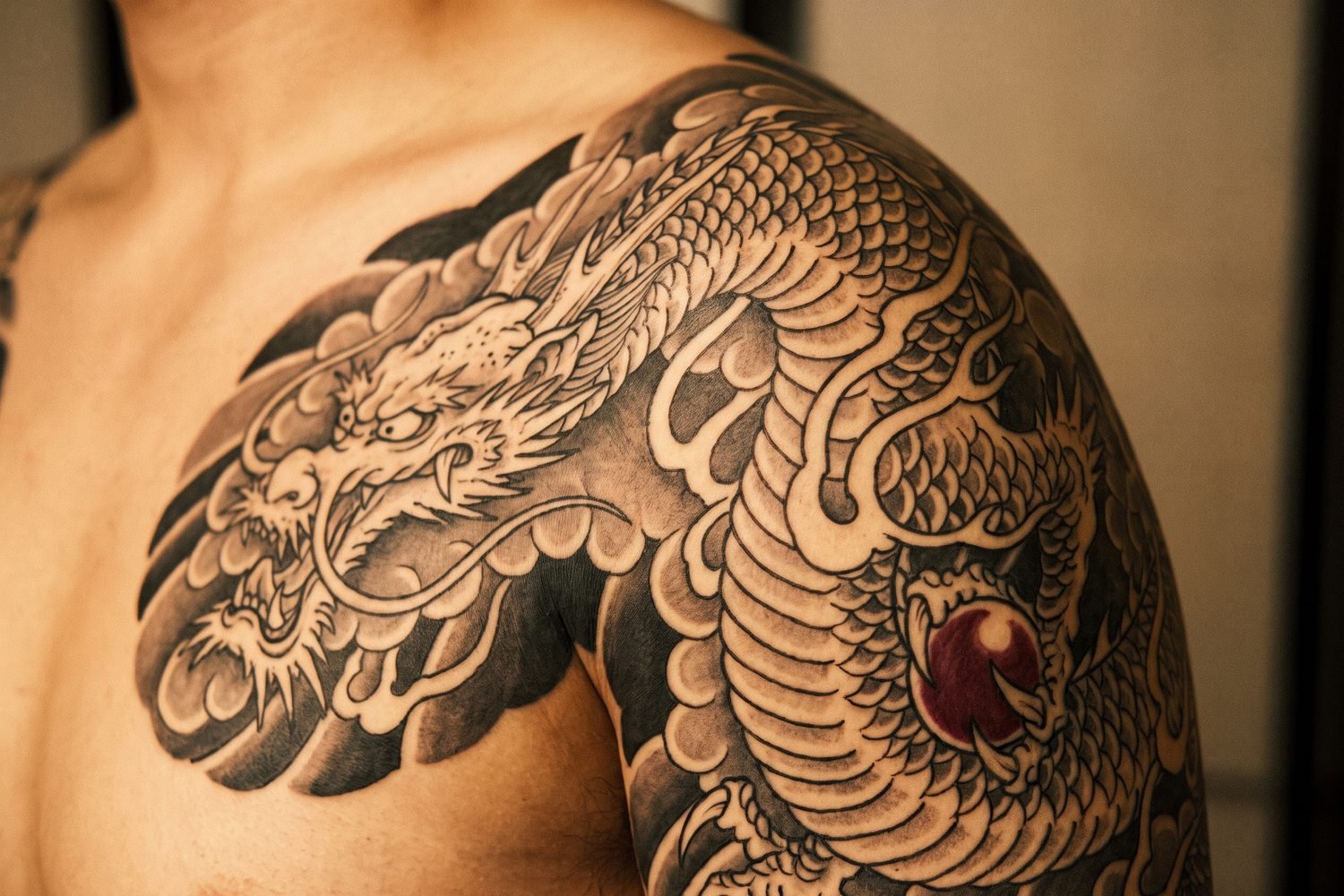
The Japanese dragon, ryu, is not the Western one. European dragons hoard, burn and are killed by knights. East Asian dragons are water creatures and benevolent forces: they bring rain, they govern rivers and seas, and they are associated with wisdom and with strength used protectively rather than destructively. Getting a dragon tattooed in this tradition is closer to claiming a guardian than claiming a monster.
Visually they are long and serpentine rather than heavy and winged, with four legs, clawed feet and a mane that trails backward as if underwater. The number of claws carries some historical weight: five claws were reserved for Chinese imperial use, and Japanese dragons are conventionally drawn with three. Most artists working today will draw three without thinking about it, which is a small sign you are in good hands.
Because the body is long and flexible, the dragon is the single most useful motif in Japanese tattooing for covering large areas. It can run the length of a back, wrap a sleeve from shoulder to wrist, or curl across a chest panel, and the coils give a composition natural places to break and resume. It is almost always paired with clouds or water, which is both symbolically right and practically necessary to fill the space between the coils.
Koi fish tattoos
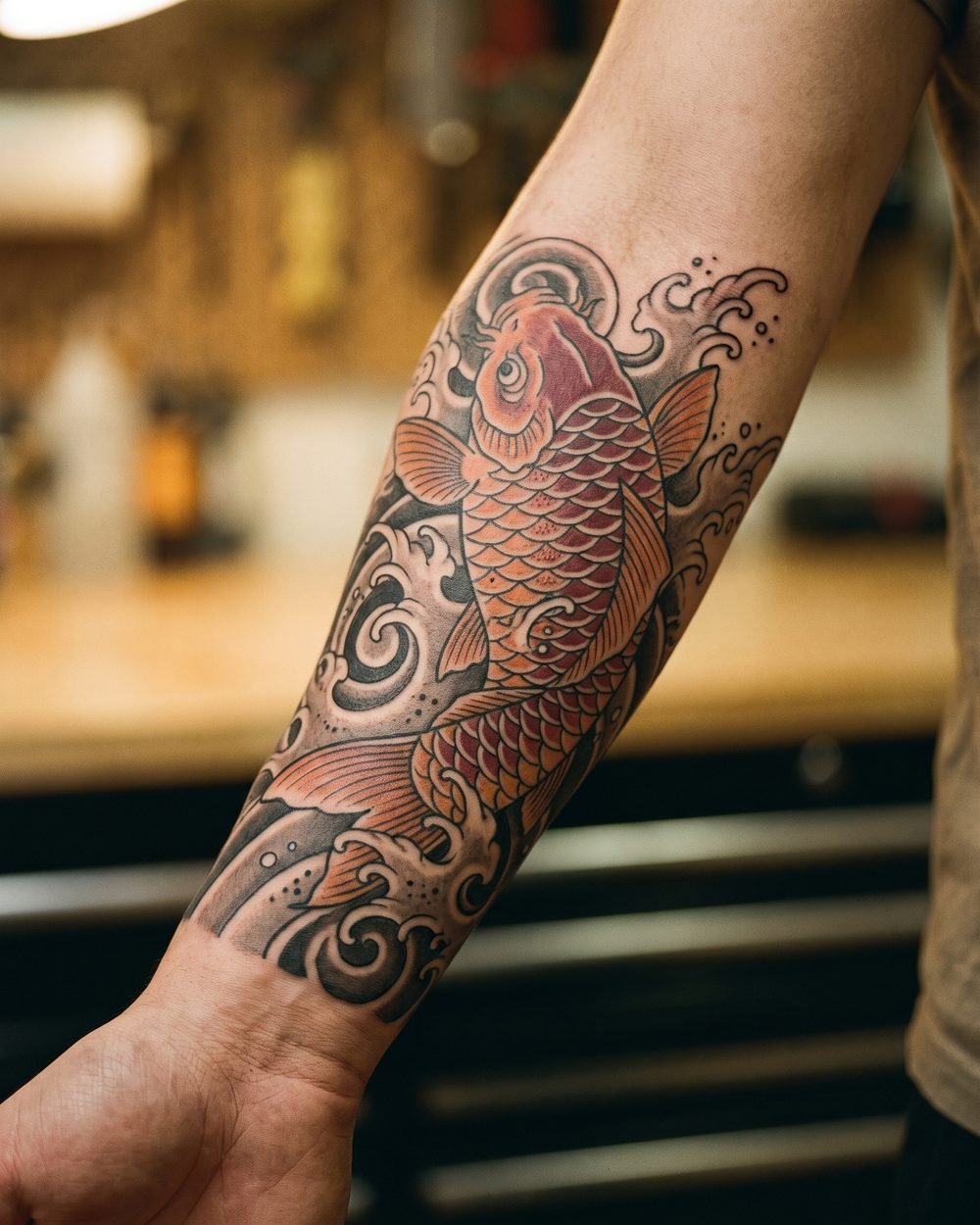
The koi carries the clearest story of any Japanese motif. In the legend, koi swim upstream against the current of the Yellow River, and any fish that manages to leap the waterfall at Dragon Gate is transformed into a dragon. The tattoo means what that story means: persistence through difficulty, and the idea that the struggle itself is what produces the transformation.
Direction is the detail people most often get wrong, and opinions among artists genuinely differ. The common reading is that a koi swimming upward is still climbing, still in the fight, while a koi swimming downward has either completed the journey or turned away from it. Some artists treat this as important and some regard it as a modern invention. If it matters to you, say so at the consultation rather than assuming.
Colour carries meaning too. Black koi are commonly associated with overcoming hardship, red with love or intense energy, and gold with wealth and success. A koi is nearly always drawn with water: rising through wave curls, with spray dots breaking around it. Without the water it reads as a fish rather than as the story.
Hannya mask tattoos
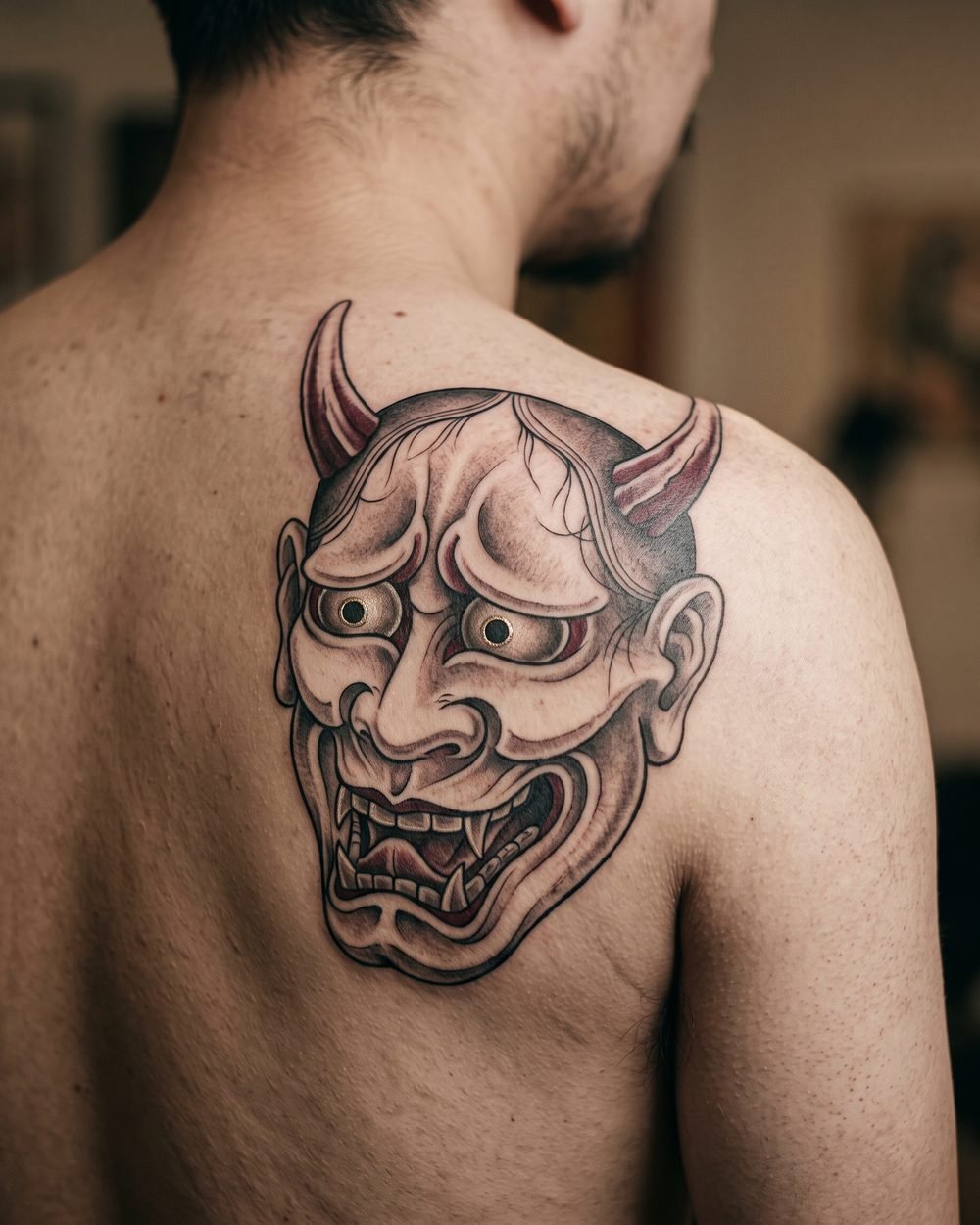
The Hannya is a mask from Noh theatre, and it is not a demon in the way most Western wearers assume. It represents a woman consumed by jealousy and grief who has become an oni, a vengeful spirit, through the intensity of her own suffering. The mask is carved to show both states at once. Tilted one way under stage lighting it reads as enraged. Tilted the other it reads as sorrowful, close to weeping.
That double reading is the whole point of the design and the reason it makes such a strong tattoo. It is not a symbol of evil. It is a symbol of what unresolved pain can turn a person into, and it carries an implicit warning rather than a threat. People often choose it to mark a period they came through, or a feeling they refuse to let define them.
Drawn correctly it has two sharp horns, wide metallic eyes, a broad mouth with visible fangs, and a deeply furrowed brow. Simplifying those features into a generic scary face loses the sorrow, which loses the meaning. Hannya is conventionally paired with maple leaves, which places it in autumn, or with snakes and spider chrysanthemums depending on the composition.
Cherry blossom tattoos
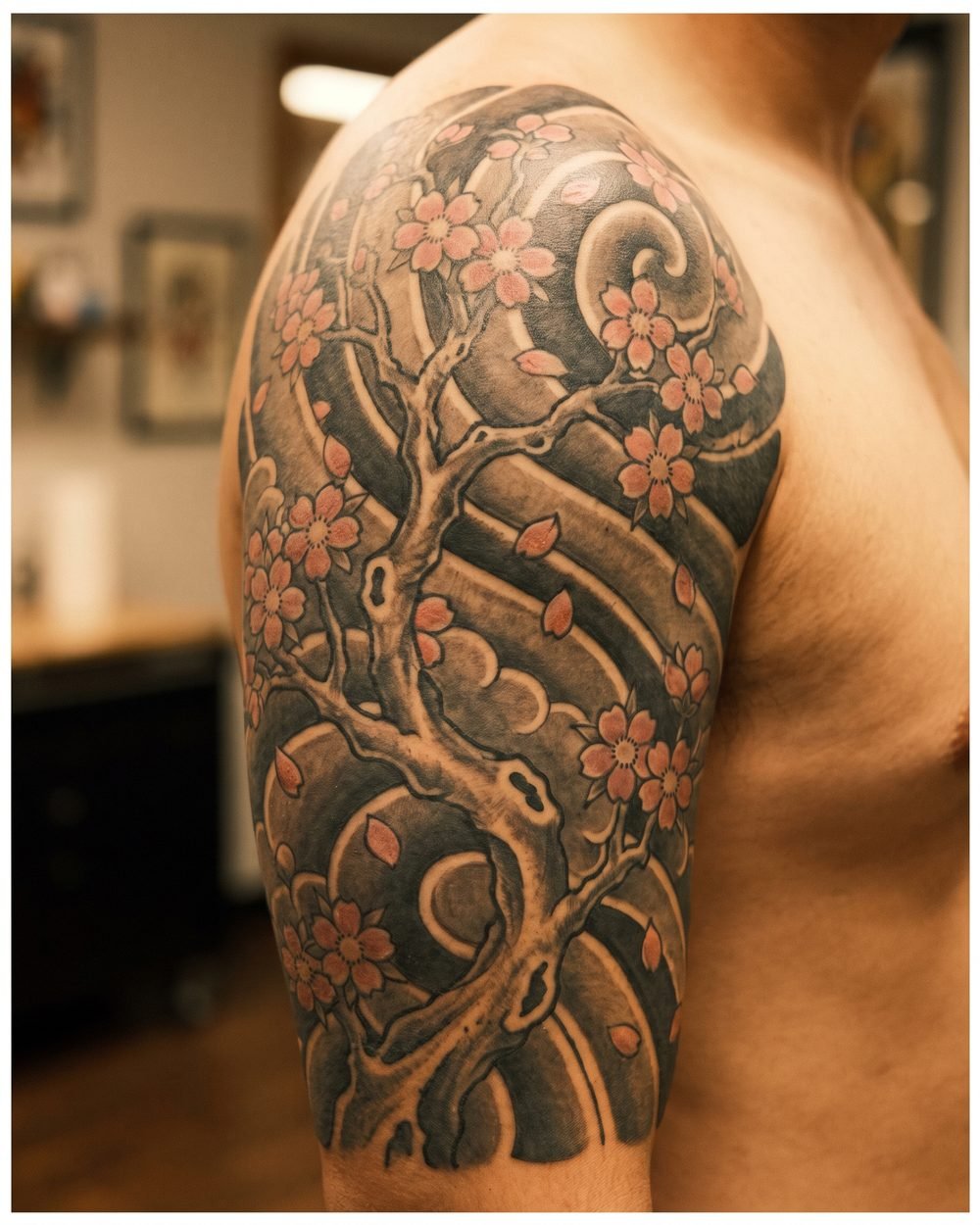
Sakura are the standard Japanese shorthand for impermanence. The blossom season lasts a week or two and then the petals fall all at once, and the cultural weight of the flower sits entirely in that brevity. In the samurai context the association was more pointed still: a life that ends early and at its peak, rather than fading slowly.
In irezumi the blossoms are rarely the subject on their own. They function as fill and as season, scattered as loose petals across wind bars between larger motifs, or massed on a thick branch that frames a dragon or a Hannya. This is where the Japanese treatment differs most visibly from the delicate Western fine-line sprig: irezumi sakura are bold, outlined, layered and dense, built to hold their own beside heavy black work rather than to sit quietly on a collarbone. If the finer approach is what you are after, the flower tattoo designs guide covers it in more depth.
Because they scatter, sakura are also the most useful motif for tying a composition together. A run of petals carried on a wind bar can connect a shoulder to a forearm and make two separate elements read as one piece.
Foo dog and shishi tattoos
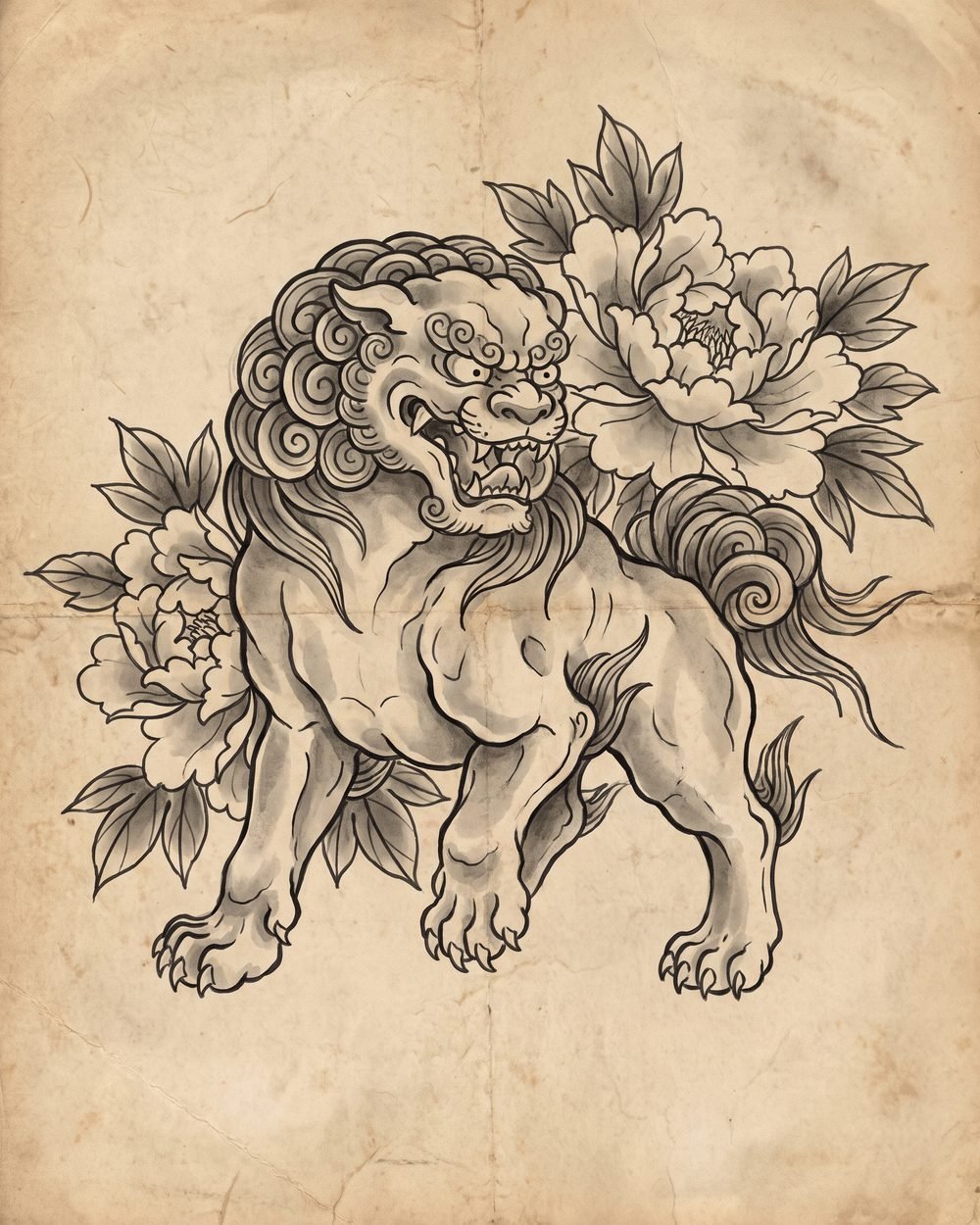
The shishi, often called a foo dog in the West, is a guardian lion. Pairs of them sit at the entrances to temples and shrines across Japan, one with its mouth open and one closed, and their job is to keep bad things out. As a tattoo the shishi carries exactly that: protection, courage, and a kind of watchfulness on the wearer’s behalf.
They are drawn as stylised lions rather than realistic ones, with curled manes, muscular compact bodies and an expression somewhere between snarling and playful. Peonies are the conventional pairing, which is where the phrase karajishi botan comes from. The lion is force and the peony is what force exists to protect, and the two are drawn together so often that a shishi without flowers can look unfinished to an experienced eye.
Compositionally the shishi is compact and dense, which makes it a good anchor for a chest panel, a shoulder cap or the top of a thigh piece. It does not stretch the way a dragon does, so it tends to sit as a focal point with background flowing around it rather than travelling across the body itself.
Waves, clouds and wind bars
The backgrounds are the part most people skip and the part that actually makes a Japanese tattoo look Japanese. In this tradition background is not filler. It is the connective tissue that turns separate motifs into a single composition, and it does three specific jobs.
The first is structural. Wave curls, cloud forms and wind bars flow around the main subjects, define the edges of the piece, and give the eye a path between elements. A dragon and a koi on the same arm with nothing between them read as two tattoos. Add water flowing from one to the other and they read as one.
The second is seasonal. Japanese motifs carry seasons, and the background is where the season is stated. Peonies and sakura place a piece in spring, maple leaves and chrysanthemums in autumn, snow and bare branches in winter. Mixing seasons carelessly is the most common mistake in Western attempts at the style, and it is the kind of thing an artist who knows the tradition will quietly correct.
The third is practical. Solid black background is what makes bright motifs read from a distance and holds a large piece together as it ages. It is also the most painful and time-consuming part of the work, which is why it is often scheduled last and why unfinished Japanese pieces so often look like floating subjects on bare skin.
Choosing an artist for Japanese work
Style matters less here than specialism. A very good realism artist is not automatically a good Japanese artist, because the difficulty in irezumi is not rendering, it is composition: knowing which motifs belong together, how background should flow around them, and how the whole limb will read once it is finished.
Three things are worth looking for in a portfolio. First, finished work rather than fresh photographs. Japanese tattoos are judged on how they settle, and an artist confident in the style will have healed pieces to show. Second, backgrounds. Plenty of artists can draw a good dragon; far fewer can build wave and cloud work that holds a sleeve together, and portfolios heavy on floating motifs with bare skin around them tell you something. Third, consistency of season and pairing across their pieces, which is the clearest sign someone understands the grammar rather than copying shapes.
Expect a longer consultation than you are used to. An artist working properly in this tradition will want to know how far you eventually intend to take the piece before they draw the first element, because a motif placed without that knowledge can block the composition later. Being told that your idea needs adjusting to work as a Japanese tattoo is a good sign, not a difficult one.
Motifs, symbolism and placement compared
The short version, if you are choosing between the five:
| Motif | Symbolism | Placements it suits |
|---|---|---|
| Dragon (ryu) | Wisdom, protection, benevolent strength | Full sleeve, back, chest panel, thigh |
| Koi | Perseverance, transformation through struggle | Forearm, outer thigh, calf, back |
| Hannya | Grief turned to rage, pain survived | Upper arm, shoulder, thigh, chest |
| Sakura | Impermanence, beauty because it is brief | Fill and background across any panel |
| Shishi (foo dog) | Protection, courage, guardianship | Chest panel, shoulder cap, upper thigh |
Composition, placement and the bodysuit
The full irezumi bodysuit, the horimono, is the form the tradition was built around. Classically it covers the back, chest, arms to the elbow and legs to the knee, with a deliberate unmarked strip down the centre of the chest called the munewari. That gap exists so the work can be concealed under an open shirt, which mattered a great deal during the years tattooing was illegal and still matters socially in Japan today.
Even if you never intend to go that far, the logic is worth borrowing, because it explains why Japanese tattoos are planned differently from Western ones. A Western sleeve is often assembled from separate pieces collected over years. A Japanese sleeve is designed as one composition from the start, and individual motifs are placed according to where they will sit on the finished arm. This is why artists who work in the style will usually want to discuss the whole limb even if you are only booking the first session.
Practical consequences
Three things follow from that. Sessions are longer and there are more of them, because background is applied in large passes rather than piece by piece. Adding to the work later is harder than in most styles, since a finished composition has no neutral space left. And placement conversations happen earlier, because the artist needs to know where the piece ends before they can draw where it begins.
Japanese motifs also appear in the older, broader Asian tattoo designs category on this site, which spans several distinct traditions. Irezumi is its own thing and worth treating separately.
Japanese tattoo designs at Miami Ink Tattoo Designs
The hard part of a Japanese tattoo is not finding a picture of a dragon. It is finding a drawing that will actually work as a tattoo on your arm, at your size, next to whatever else you plan to add later. A screenshot of someone else’s finished sleeve tells you none of that.
What a design library gives you is narrower and more useful: designs organised by subject so you can compare dozens of koi side by side, a way to save the ones that survive a second look, and files you can print and hold against your skin before anyone picks up a machine. Most designs are full resolution, though the size can vary depending on the source of the design. Every image can be pinned for reference at any time and shared with your tattoo artist, which matters more in this style than most, because a Japanese piece is planned as a whole rather than booked one session at a time.
Alongside Japanese work the library covers more than 60 categories including dragon tattoo designs, Chinese tattoo designs and tribal tattoo designs.
Start browsing Japanese tattoo designs
Access the full library for $9.97 a month, cancel any time, with a 30-day money-back guarantee. Checkout completes securely on ClickBank.
Frequently asked questions
What is irezumi?
Irezumi is the Japanese tattoo tradition that took shape in Edo period Japan during the eighteenth and nineteenth centuries. It grew directly out of ukiyo-e woodblock printing, particularly Kuniyoshi’s illustrations of the Suikoden, and it is defined less by a drawing style than by a system of motifs, seasonal pairings and whole-body composition.
What Japanese tattoo designs does Miami Ink Tattoo Designs offer?
The library covers dragons, koi, Hannya and other Noh masks, shishi guardian lions, tigers, snakes, phoenixes, samurai and geisha figures, along with the sakura, peony, maple and chrysanthemum motifs and the wave, cloud and wind bar backgrounds that tie a composition together. Japanese designs sit inside a wider set of more than 60 categories.
What does a Japanese dragon tattoo mean?
In the Japanese reading a dragon is a benevolent water deity associated with wisdom, rain and protective strength, which is close to the opposite of the destructive Western dragon. It is drawn long and serpentine with three claws, and it is nearly always paired with clouds or water. It suits large placements because the coiled body fills space naturally.
Does the direction a koi swims change its meaning?
The common reading is that a koi swimming upward is still striving and one swimming downward has completed the journey or turned back from it. Artists genuinely differ on how much weight this carries, and some regard it as a recent addition rather than a traditional rule. If the distinction matters to you, raise it at the consultation rather than assuming.
Is a Hannya mask tattoo a demon?
Not quite. The Hannya is a Noh theatre mask representing a woman transformed into a vengeful spirit by jealousy and grief. It is carved to read as enraged from one angle and sorrowful from another, and that duality is the point. It stands for pain that has consumed someone, so it works as a warning or a marker of something survived rather than as a symbol of evil.
Can I get a Japanese tattoo if I am not Japanese?
Tattooers working in the tradition, in Japan and elsewhere, generally welcome it when the work is done properly and the motifs are understood rather than picked for looks. What draws criticism is treating the imagery as decoration, mixing incompatible motifs or seasons, or using Japanese script without checking it. Working with an artist who knows the style resolves most of this.
Why are tattoos banned at some Japanese onsen and pools?
Tattooing was outlawed in Japan for most of the period between 1872 and 1948, which pushed it underground and tied it in the public mind to organised crime. Many onsen, gyms and public pools still refuse entry to visibly tattooed guests, including tourists. Some facilities now allow cover patches or are tattoo friendly, but it is worth checking before you travel.
What is tebori?
Tebori is the traditional hand technique, applying ink with needles bound to a rod and worked into the skin at an angle rather than with a machine. It is slower and many collectors prefer the quality of its colour packing, particularly across large solid areas. Most Japanese style work today is done by machine, and plenty of artists combine the two.
How long does a Japanese sleeve take?
Considerably longer than a Western sleeve of the same size, because the background is applied in large passes rather than piece by piece and the whole composition is designed up front. Expect multiple long sessions spread over months. Your artist will usually want to plan the entire limb before starting, even if you are only booking the first sitting.
How do I take a Miami Ink Tattoo Designs Japanese design to my artist?
Pin the designs you are weighing up, then print the one you settle on at the size you want it. Bring the printed sheet to your consultation rather than a phone screenshot. Paper can be held against your skin, rotated and trimmed, which lets your artist judge how the motif will flow around the limb and where the background will need to go.
Choosing yours
Start with the motif that means something to you, then talk to an artist about what it needs around it. In this tradition the companion elements are not optional decoration. A dragon without clouds, a koi without water or a shishi without peonies will always look like it is missing something, because it is.
Print your shortlist, hold it against the limb it is meant for, and give it a week. Japanese work rewards patience more than most styles, and the planning is where most of the quality comes from.
Browse other tattoo design categories
- Abstract tattoo designs
- Alien tattoo designs
- Ambigram tattoo designs
- Angel tattoo designs
- Animal tattoo designs
- Aztec tattoo designs
- Belly button tattoo designs
- Biker tattoo designs
- Bird tattoo designs
- Butterfly tattoo designs
- Cartoon tattoo designs
- Celebrity tattoo designs
- Celtic tattoo designs
- Chinese tattoo designs
- Chinese zodiac tattoo designs
- Clown tattoo designs
- Cross tattoo designs
- Demon tattoo designs
- Devil tattoo designs
- Dolphin tattoo designs
- Dove tattoo designs
- Dragon tattoo designs
- Eagle tattoo designs
- Flower tattoo designs
- Skull tattoo designs
- Star tattoo designs
- Tribal tattoo designs
Written by the Miami Ink Tattoo Designs team. We have run a membership tattoo design library since 2009, serving members and tattoo artists who use the collection at the chair. Design guidance here is general, and cultural notes are a starting point rather than the last word. Your artist is the right person to advise on your skin, your placement and your specific piece.