Skull Tattoos: Meaning and Design Guide
The skull is the oldest image in tattooing that still means what it always meant. Sailors wore it, soldiers wore it, bikers wore it, and the people getting one today are drawing on the same idea those groups were: you are going to die, so decide what you are doing with the time. That is the whole of it. Everything else is style.
What changes between a traditional skull on a forearm and a decorated calavera on a thigh is not the subject but the argument being made about it. Some skulls are warnings. Some are memorials. One tradition, the Mexican one, is a celebration and it is worth understanding properly before you wear it. This guide covers the five styles people actually ask for, what each one carries, how they age, and where they sit on the body. Every design mentioned is in the Miami Ink Tattoo Designs library, so you can print one at size and take it to your artist.
Key Takeaways
- Skull tattoos are usually about mortality, but the tone ranges from warning to memorial to celebration depending on style.
- American traditional skulls have the heaviest linework of any style here and age more predictably than detailed realism.
- Sugar skulls come from Dia de los Muertos, a Mexican tradition honouring the dead, and carry specific decorative conventions worth respecting.
- Skull and roses is the classic memento mori pairing: death beside beauty, usually chosen to mark a loss.
- Miami Ink Tattoo Designs members can browse thousands of skull designs across 60+ categories and print any of them at true scale before booking.
Find your skull tattoo design
Members browse 30,000+ designs across 60+ categories, pin the ones worth a second look, and print them at true scale before booking.
Traditional and Americana skull tattoos
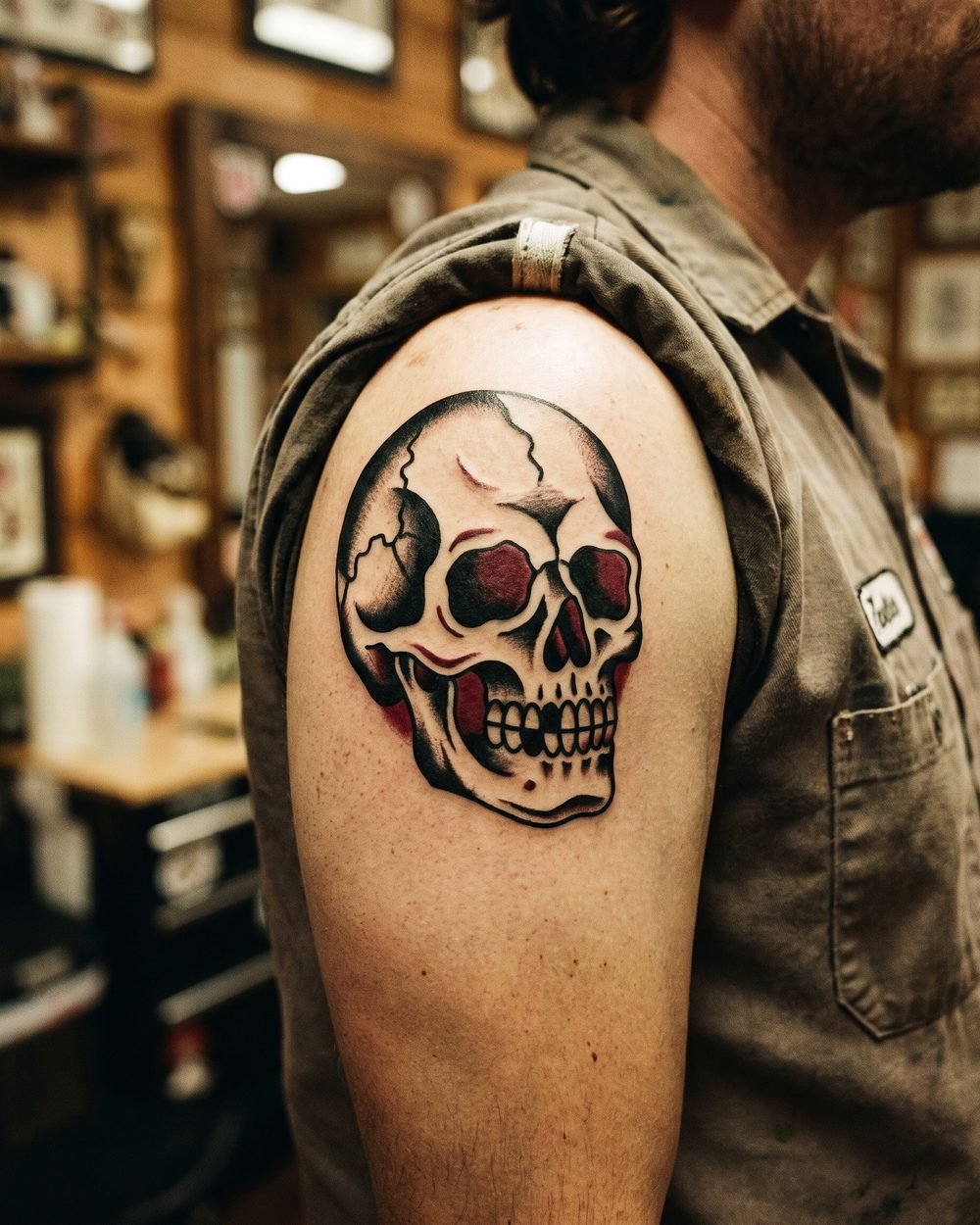
American traditional is where the tattooed skull became a fixed image rather than a one-off drawing. Sailors and servicemen carried it through the first half of the twentieth century, and the shops that served them settled on a construction that has barely changed: a heavy black outline, flat areas of solid black in the eye sockets and nasal cavity, and very little else. No gradients, no fine texture, no attempt at anatomy.
That restraint is the point. A traditional skull is not trying to look like a real skull. It is a symbol, drawn to be legible from across a room and to stay legible for fifty years. Because the design is built from separated shapes with clear gaps between them, it survives the slow spread that happens to all ink under the skin. The tattoos from the 1940s that still read correctly are almost all built this way.
What it usually means
In its original context the traditional skull was a straightforward memento mori worn by people whose work carried real risk. It said that the wearer knew the odds and had made peace with them. Paired with a dagger it becomes more pointed, closer to a threat or a survived betrayal. Paired with wings or an hourglass it moves towards time running out. On its own, most people wearing one today mean something closer to a reminder to get on with it.
Who it suits
This is the most forgiving skull style for a first tattoo and the easiest to place. It works at three inches on a forearm and at twelve on a chest, and it sits comfortably next to other traditional work if you are building a sleeve over time. If you want a skull that will still look like a skull in 2050, start here.
Sugar skull tattoos and Dia de los Muertos
The decorated skull most people call a sugar skull is a calavera, and it belongs to Dia de los Muertos, the Mexican observance held on the first two days of November. It is worth being clear about what that tradition is, because it is routinely mistaken for a Mexican version of Halloween and it is not.
Dia de los Muertos is a remembrance. Families build altars, called ofrendas, for relatives who have died, and put out the food, drink and objects that person liked in life. The marigolds, the candles and the photographs are there to help the dead find their way back for a visit. The mood is not fearful. It is closer to a family gathering where some of the people are no longer alive, and the sweetness of the decoration is the point: death is treated as part of the family rather than as an enemy. The sugar calaveras themselves are confections, often made with a person’s name written on the forehead.
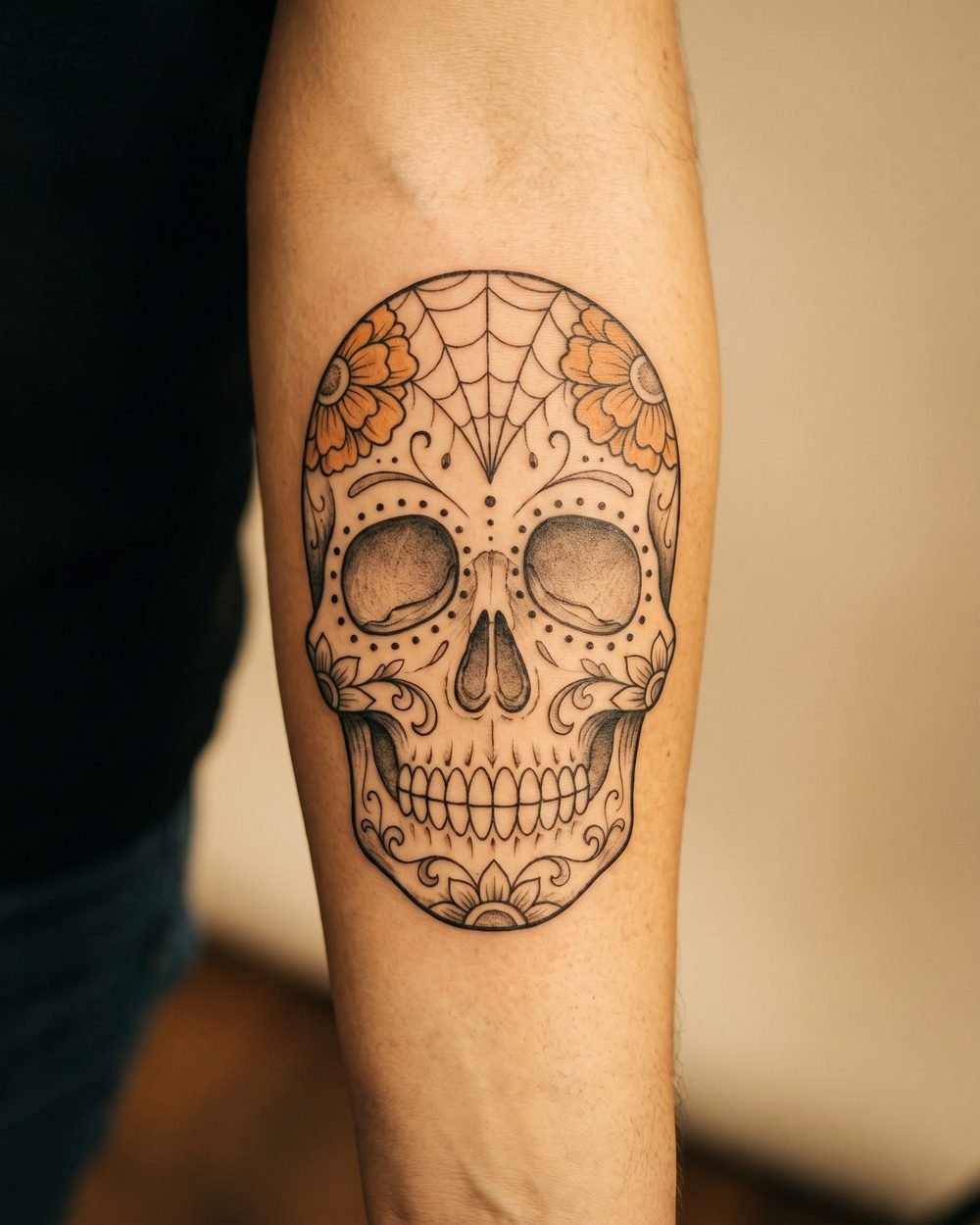
That is what a calavera tattoo carries when it is done properly. It is a memorial and a celebration at once, usually worn for a specific person. The decorative conventions are not arbitrary either. Marigolds, the cempasuchil flower, appear because they are the flower of the dead. Scrollwork on the cheekbones, a row of dots around the eye sockets and web-like filigree across the forehead are all standard. Colour is normally bright and deliberate.
If you are not Mexican, this is a design worth approaching with some care rather than avoidance. Wearing a calavera as a memorial for someone you have lost sits comfortably inside what the tradition is for. Wearing one because it looks good and calling it a generic cool skull is where people reasonably take issue. Talk to your artist about it, and if the tattoo is for a particular person, consider having their name worked in the way the sugar skulls themselves carry names. Related cultural motifs sit in the Aztec tattoo designs category.
Realism skull tattoos
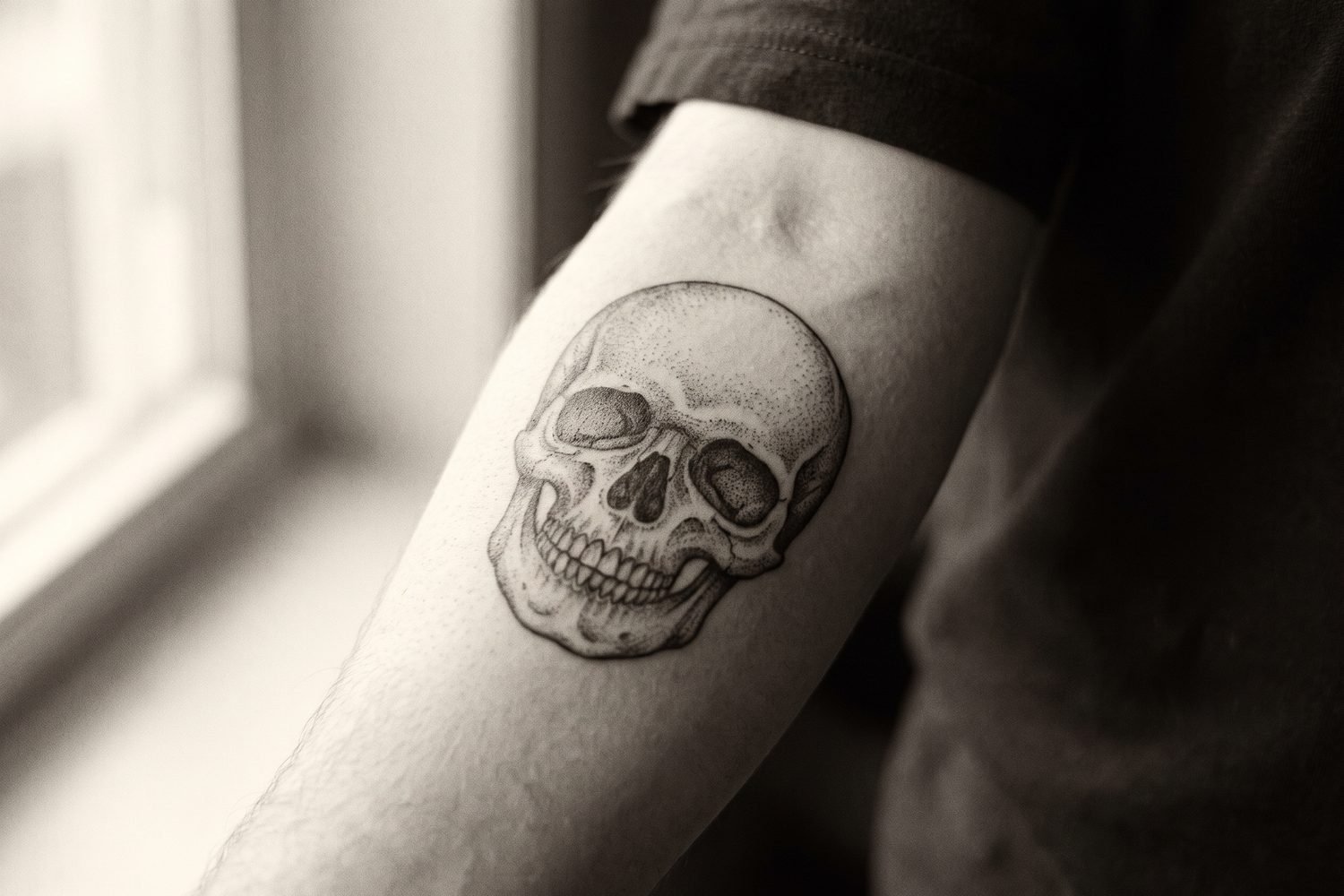
Realism goes the opposite direction from traditional work. Instead of a symbol it aims at an object: correct anatomy, real proportion, light falling across bone from a specific direction. Done well it is the most technically demanding style on this page and the most impressive in person.
It is also the least forgiving. Realism depends entirely on subtle tonal transitions, and those transitions are the first thing to go as a tattoo ages. Fine stipple shading in a cheekbone can soften into a flat grey patch over fifteen years, which is why experienced realism artists build in more contrast than the reference photo shows. They are drawing for how it will look in a decade, not for how it photographs next week.
Two practical points if you want one. Size matters more here than in any other style: a realistic skull under about five inches rarely holds its detail, because there is not enough room for the tonal range that makes it read as three-dimensional. And artist selection matters more than it does for traditional work. Realism is a specialism, not a setting, and the gap between a good realism artist and a general practitioner is visible immediately.
Skull and roses tattoos
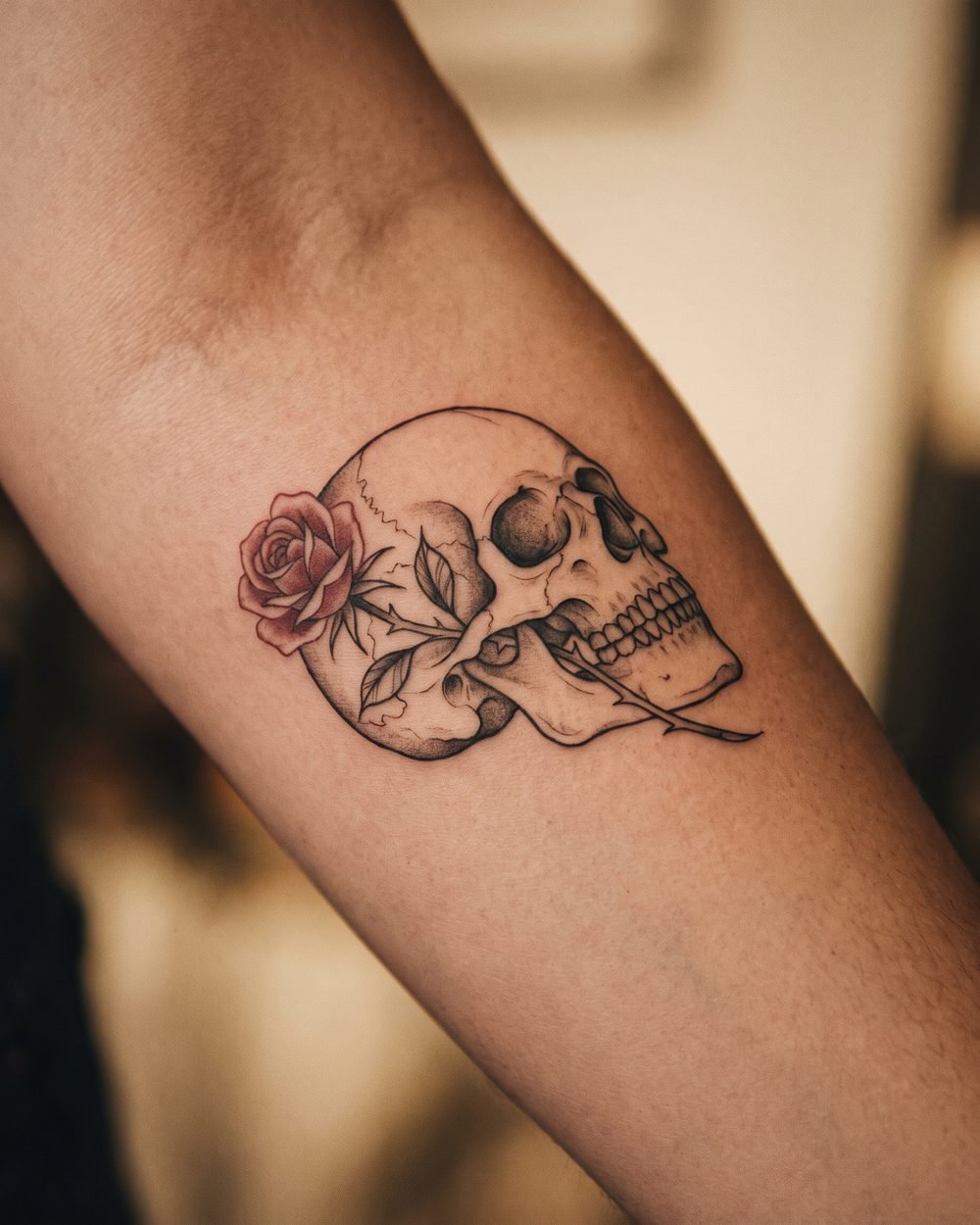
Skull and roses is the oldest pairing in Western tattooing after the skull alone, and it is a straight statement of memento mori: the bone and the bloom in the same frame, one permanent and one already dying. Put simply, it says that beauty and death are the same subject seen from different sides.
The combination is common on memorial tattoos for that reason. A skull on its own reads as a statement about mortality in general. Add a rose and it usually becomes about a particular person. Many artists will place the rose so that it partly covers or grows through the skull, which reads as life continuing rather than simply sitting beside death.
Compositionally the pairing is also just practical. A skull is a hard, closed shape with a strong silhouette and not much to break it up. A rose brings curves, softer edges and a natural place to run a stem, which gives the whole design somewhere to go on the body. That is why it wraps a forearm or a calf so comfortably. If the flower half is what draws you, the flower tattoo designs guide covers rose styles in more depth.
Biker and skull and crossbones tattoos
The skull and crossbones has a longer history than motorcycle culture. It appears on gravestones from the seventeenth century, on military insignia, and on maritime flags long before it turned up on a tank badge. What biker culture added was attitude rather than meaning: the same symbol worn deliberately as a statement of independence and of a willingness to accept risk that other people avoid.
Stylistically this is the heaviest work on the page. Thick outlines, solid black fill, high contrast and very little subtlety, often combined with flames, wings, engines or banner ribbons. It is designed to be read at speed and from a distance, which is a genuine design constraint rather than a lack of refinement.
Because the linework is so heavy it ages extremely well, arguably better than any other style here. The trade-off is that heavy black is difficult to cover or rework later, so it is worth being more certain about placement than you would be with a lighter design. Related bold-line work sits in the biker tattoo designs and tribal tattoo designs categories.
Colour or black and grey?
Skulls are one of the few subjects where this is a real decision rather than a preference. Bone has no colour of its own, so any colour in a skull tattoo is doing something deliberate: it is either decoration, as in a calavera, or contrast, as in the red of a rose against grey bone.
Black and grey is the default for a reason. It suits the subject, it blends with almost any future work, and it holds up better than colour over decades because there is no pigment shift to worry about. Reds and yellows fade faster than black under ultraviolet light, which is why a colour piece on a forearm that sees daily sun will usually need a touch-up years before a black and grey one on the same arm.
Colour earns its place in two situations. The first is the sugar skull, where the decoration is the meaning and stripping it to grey removes most of what makes it a calavera rather than a skull. The second is a single accent, most often a red rose or a small amount of marigold orange, used to pull the eye to one part of an otherwise monochrome design. That approach ages well because the black structure carries the tattoo and the colour is a bonus rather than a dependency.
What tends not to work is colour spread evenly across a large skull with no black anchoring it. Without strong dark values the design flattens as it settles and reads as a pale smudge from a distance. If you want a colourful skull, ask your artist to keep the outline and the deepest shadows solid black and let colour do the rest.
Skull styles, symbolism and placement compared
The short version, if you are deciding between the five:
| Style | Common symbolism | Placements it suits |
|---|---|---|
| Traditional | Mortality accepted, risk understood | Forearm, upper arm, chest, calf |
| Sugar skull | Honouring a specific person, celebration of a life | Thigh, upper arm, back, ribs |
| Realism | Mortality as fact rather than symbol | Outer forearm, thigh, back, upper arm |
| Skull and roses | Memorial, beauty and death together | Forearm, calf, shoulder, ribs |
| Biker | Independence, accepted risk, defiance | Upper arm, back, chest, outer calf |
Why the skull has outlasted every other tattoo subject
Skulls appear in funerary art across almost every culture that has left art behind, and the reason is not morbidity. A skull is the one image that is unambiguously about death while being completely impersonal. It has no age, no gender, no nationality and no expression. Anyone can look at one and see themselves.
European memento mori art made that explicit from the late medieval period onward: skulls placed beside wealth, youth or beauty in paintings to remind the viewer that none of it lasts. Tattooing inherited the idea more or less intact through sailors and soldiers, who had better reasons than most to think about it. The modern version has softened, but the structure is the same. A skull tattoo is a statement about time.
It is also the most versatile subject in flash. Because the shape is hard, symmetrical and closed, it combines with almost anything: flowers soften it, daggers sharpen it, ornament transforms it entirely. That flexibility is why it survives every change in tattoo fashion while more specific subjects come and go.
Choosing size and placement
Skulls are less flexible about size than flowers, because the shape is fixed. A rose can lose a petal and still be a rose. A skull that is too small loses the eye sockets and nasal cavity to spread, and once those close up it stops reading as a skull at all and becomes a grey oval.
As a rough floor, a traditional skull works from about three inches, a skull and roses composition from about four, and realism from about five. Below those sizes you are asking the design to hold detail it does not have room for. If you want something smaller, choose a style built from fewer, heavier marks rather than shrinking a detailed drawing.
The test is the same one that works for any tattoo. Print the design at the exact size you are considering, cut it out and tape it where it will go. Look at it in a mirror, then again the next morning. Skulls in particular benefit from this because their symmetry makes bad placement obvious: a skull sitting slightly off the centre line of a forearm or chest looks wrong in a way a flower never would.
How skull tattoos age
Every tattoo softens. Ink spreads slightly in the dermis over decades, lines thicken, and the smallest gaps close first. What differs between styles is how much that process costs them.
Heavy-line work loses the least. A traditional skull or a biker piece is built from marks thick enough that a small amount of spread changes nothing important, which is why those tattoos still look intentional after forty years. Realism loses the most, because it depends on tonal transitions that flatten as they blur. Sugar skulls sit in between and depend on how densely the ornamentation is packed: widely spaced decoration holds, crowded filigree merges.
Two things are worth doing regardless of style. Keep it out of direct sun once healed, because ultraviolet exposure fades black ink faster than time alone does, and resist the urge to cram detail in. The design that looks slightly too open on day one is usually the one that still reads properly in twenty years. There is a fuller routine in the guide to tattoo aftercare do’s and don’ts.
Skull tattoo designs at Miami Ink Tattoo Designs
The hard part of choosing a skull tattoo is not finding images. It is comparing them properly. A saved screenshot is someone else’s finished tattoo at an unknown size, usually cropped, and it tells you nothing about whether the same design works at four inches on your forearm.
What a design library actually gives you is narrower than people expect and more useful. Designs organised by subject so you can compare fifty skulls side by side instead of scrolling, a way to save the ones that survive a second look, and files you can print and hold against your skin before anyone picks up a machine. Most designs are full resolution, though the size can vary depending on the source of the design. Every image can be pinned for reference at any time and shared with your tattoo artist.
Alongside skulls the library covers more than 60 categories including demon tattoo designs, Celtic tattoo designs and dragon tattoo designs, which combine naturally with skull work in larger pieces.
Start browsing skull tattoo designs
Access the full library for $9.97 a month, cancel any time, with a 30-day money-back guarantee. Checkout completes securely on ClickBank.
Frequently asked questions
What do skull tattoos mean?
Most skull tattoos are a form of memento mori, a reminder that life is finite and worth using. The exact reading shifts with style and context. Traditional skulls suggest accepted risk, skull and roses usually marks a specific loss, and a decorated calavera honours a particular person. On its own a skull is a statement about time rather than a threat.
What skull tattoo designs does Miami Ink Tattoo Designs offer?
The library covers American traditional and neo-traditional skulls, black and grey realism, sugar skull calaveras, skull and roses compositions, skull and crossbones, anatomical studies, and skulls combined with daggers, snakes, wings and clock faces. Skull designs sit inside a wider set of more than 60 categories, so they can be combined with other subjects for larger pieces.
Are sugar skull tattoos disrespectful?
Not inherently, but context matters. The calavera comes from Dia de los Muertos, a Mexican tradition for honouring relatives who have died. Worn as a memorial for someone you have lost, it sits comfortably inside what the tradition is for. Treating it as a generic decorative skull with no connection to that meaning is what people reasonably object to. Talking it through with your artist is worthwhile.
What is the difference between a sugar skull and a regular skull tattoo?
A regular skull is drawn as bone. A sugar skull, or calavera, is a decorated confection from Dia de los Muertos and follows specific conventions: marigold flowers, scrollwork on the cheekbones, dots around the eye sockets and filigree across the forehead, usually in bright colour. The meanings differ too. One is about mortality in general, the other honours a specific person.
How small can a skull tattoo be?
A traditional skull works from roughly three inches, skull and roses from about four, and realism from about five. Below those sizes the eye sockets and nasal cavity close up as the ink spreads, and the design stops reading as a skull. If you want something smaller, choose a style built from fewer heavy marks rather than shrinking a detailed drawing.
Do skull tattoos age well?
It depends entirely on style. Traditional and biker skulls age better than almost any other tattoo because heavy lines tolerate the slow spread of ink. Realism ages worst, since it relies on subtle tonal transitions that flatten over time. Good artists compensate by building in more contrast than the reference shows.
Where do skull tattoos hurt least?
Outer forearm, outer thigh, calf and upper arm are the most comfortable, since there is more tissue between the needle and the bone. Ribs, sternum, spine and the tops of the feet are noticeably sharper. Larger skull pieces often need multiple sessions, so placement affects how long you will be sitting as well as how much it hurts.
Can a skull tattoo cover an old tattoo?
Often yes. Skulls carry a lot of solid black and high contrast, which is exactly what absorbs an existing design. Traditional and biker styles are the strongest cover-up candidates for that reason. Any cover-up needs assessing in person, because what is possible depends on how dark and how large the original piece is.
What goes well with a skull tattoo?
Roses are the classic pairing and read as memento mori. Daggers sharpen the meaning towards betrayal or survival, snakes add rebirth, moths and clock faces reinforce the passage of time, and wings suggest release. Choosing a companion element is also practical, since it gives an otherwise closed shape somewhere to flow on the body.
How do I take a Miami Ink Tattoo Designs skull design to my artist?
Pin the designs you are weighing up, then print the one you settle on at the size you want it. Bring the printed sheet to your consultation rather than a phone screenshot. Paper can be held against your skin, rotated and trimmed, which lets your artist judge scale and symmetry immediately and adapt the drawing to your body.
Choosing yours
Decide what you want the tattoo to say before you choose the style, because with skulls the style is the argument. A traditional skull and a realism skull of the same size on the same arm are making different statements about the same subject.
Then work backwards from placement and size, print your shortlist, and let it sit a few days before booking. The ones still there at the end of the week are usually right.
Browse other tattoo design categories
- Abstract tattoo designs
- Alien tattoo designs
- Ambigram tattoo designs
- Angel tattoo designs
- Animal tattoo designs
- Asian tattoo designs
- Aztec tattoo designs
- Belly button tattoo designs
- Biker tattoo designs
- Bird tattoo designs
- Butterfly tattoo designs
- Cartoon tattoo designs
- Celebrity tattoo designs
- Celtic tattoo designs
- Chinese tattoo designs
- Chinese zodiac tattoo designs
- Clown tattoo designs
- Cross tattoo designs
- Demon tattoo designs
- Devil tattoo designs
- Dolphin tattoo designs
- Dove tattoo designs
- Dragon tattoo designs
- Eagle tattoo designs
- Flower tattoo designs
- Star tattoo designs
- Tribal tattoo designs
Written by the Miami Ink Tattoo Designs team. We have run a membership tattoo design library since 2009, serving members and tattoo artists who use the collection at the chair. Design guidance here is general. Your artist is the right person to advise on your skin, your placement and your specific piece.